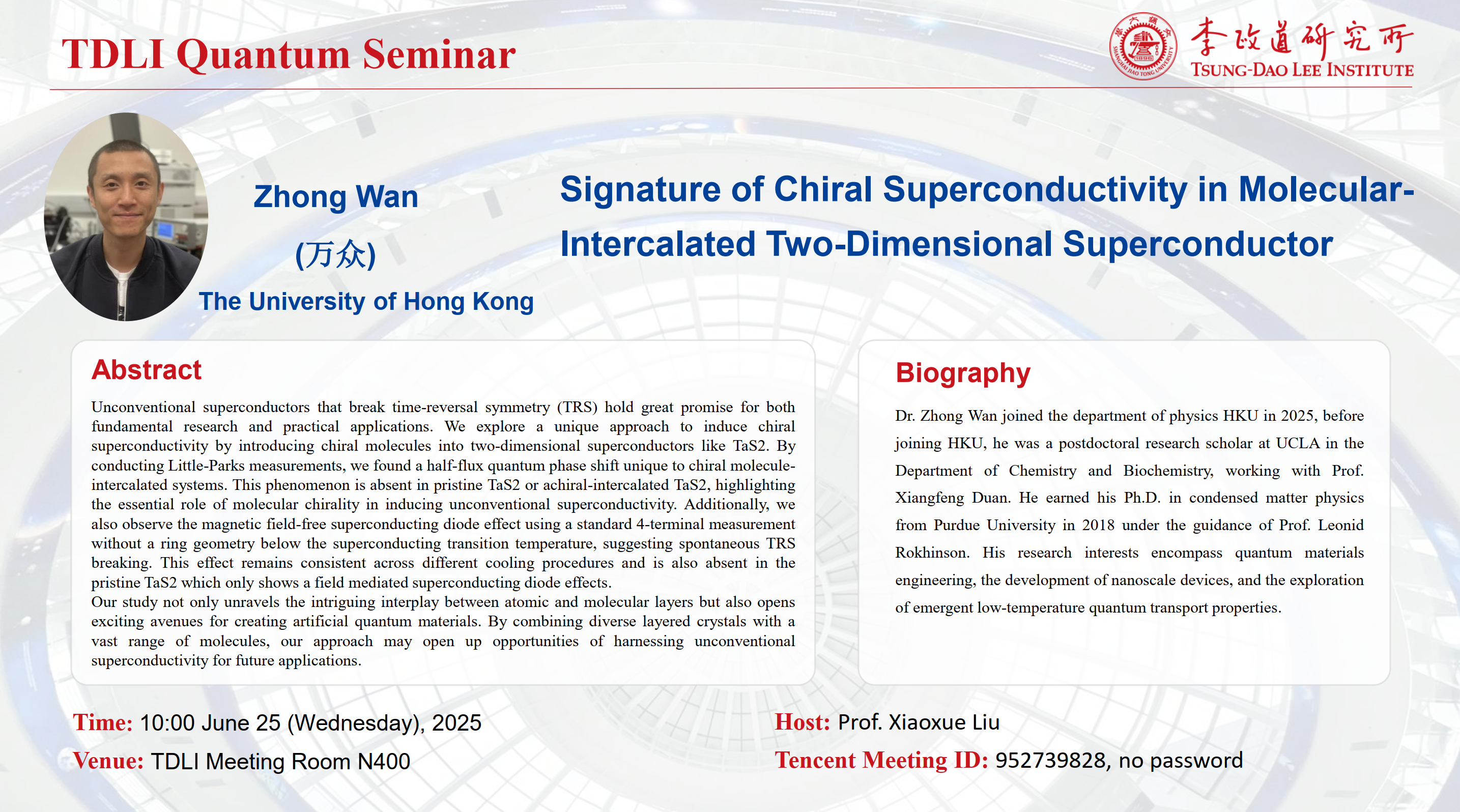
Signature of Chiral Superconductivity in Molecular-Intercalated Two-Dimensional Superconductor
by
Tsung-Dao Lee Institute/N4F-N400 - meeting room
Tsung-Dao Lee Institute
Host: Prof. Xiaoxue Liu
Venue: TDLI Meeting Room N400
Tencent Meeting link: https://meeting.tencent.com/dm/eG2NOkcFg2sb
Meeting ID: 952739828, no password
Abstract:
Unconventional superconductors that break time-reversal symmetry (TRS) hold great promise for both fundamental research and practical applications. We explore a unique approach to induce chiral superconductivity by introducing chiral molecules into two-dimensional superconductors like TaS2. By conducting Little-Parks measurements, we found a half-flux quantum phase shift unique to chiral molecule-intercalated systems. This phenomenon is absent in pristine TaS2 or achiral-intercalated TaS2, highlighting the essential role of molecular chirality in inducing unconventional superconductivity. Additionally, we also observe the magnetic field-free superconducting diode effect using a standard 4-terminal measurement without a ring geometry below the superconducting transition temperature, suggesting spontaneous TRS breaking. This effect remains consistent across different cooling procedures and is also absent in the pristine TaS2 which only shows a field mediated superconducting diode effects.
Our study not only unravels the intriguing interplay between atomic and molecular layers but also opens exciting avenues for creating artificial quantum materials. By combining diverse layered crystals with a vast range of molecules, our approach may open up opportunities of harnessing unconventional superconductivity for future applications.
Biography:
Dr. Zhong Wan joined the department of physics HKU in 2025, before joining HKU, he was a postdoctoral research scholar at UCLA in the Department of Chemistry and Biochemistry, working with Prof. Xiangfeng Duan. He earned his Ph.D. in condensed matter physics from Purdue University in 2018 under the guidance of Prof. Leonid Rokhinson. His research interests encompass quantum materials engineering, the development of nanoscale devices, and the exploration of emergent low-temperature quantum transport properties.