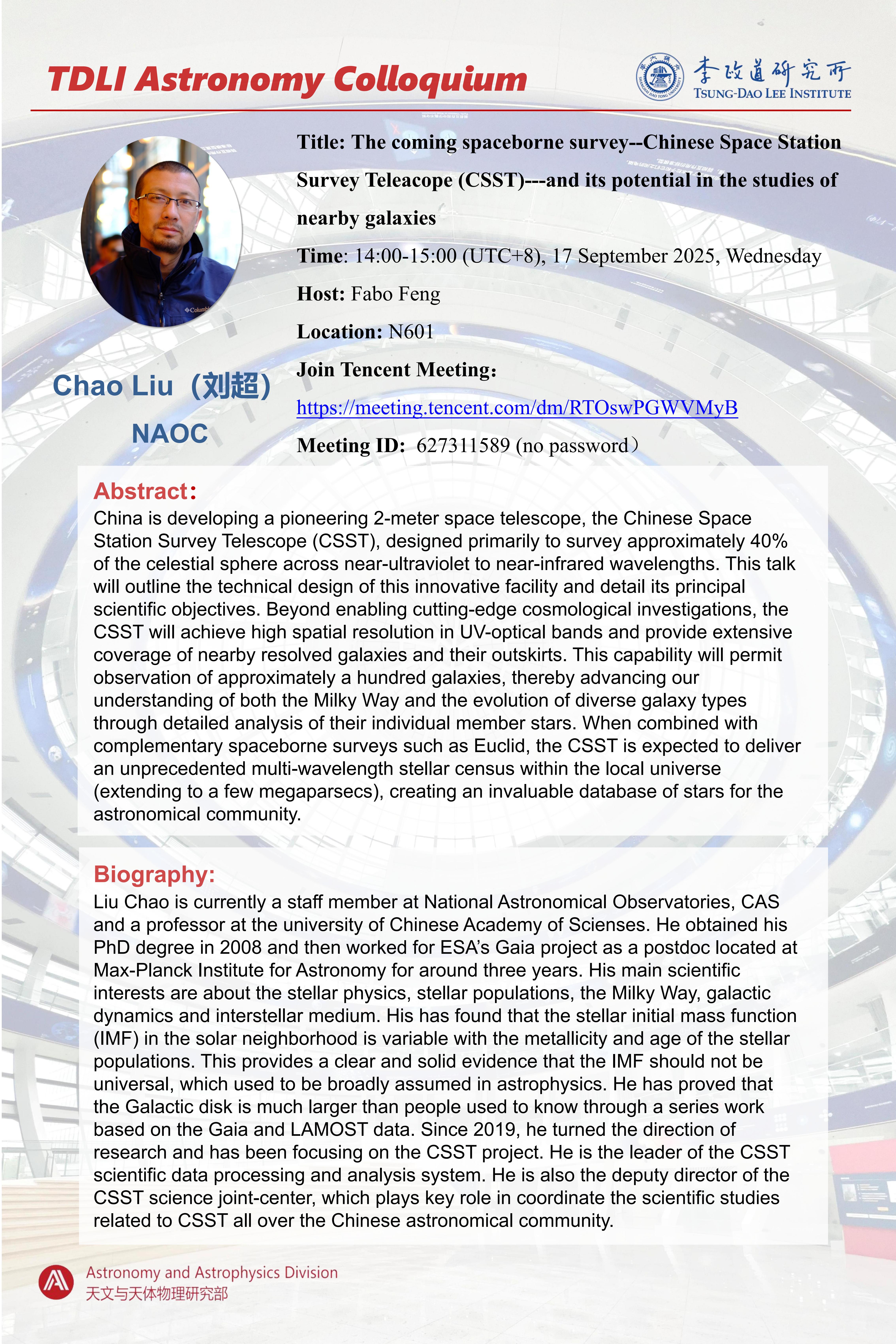
The coming spaceborne survey--Chinese Space Station Survey Teleacope (CSST)---and its potential in the studies of nearby galaxies
by
Tsung-Dao Lee Institute/N6F-N601 - Meeting Room
Tsung-Dao Lee Institute
Host: Fabo Feng
Join Tencent Meeting:https://meeting.tencent.com/dm/RTOswPGWVMyB
Meeting ID: 627311589 (no password)
Abstract:
China is developing a pioneering 2-meter space telescope, the Chinese Space Station Survey Telescope (CSST), designed primarily to survey approximately 40% of the celestial sphere across near-ultraviolet to near-infrared wavelengths. This talk will outline the technical design of this innovative facility and detail its principal scientific objectives. Beyond enabling cutting-edge cosmological investigations, the CSST will achieve high spatial resolution in UV-optical bands and provide extensive coverage of nearby resolved galaxies and their outskirts. This capability will permit observation of approximately a hundred galaxies, thereby advancing our understanding of both the Milky Way and the evolution of diverse galaxy types through detailed analysis of their individual member stars. When combined with complementary spaceborne surveys such as Euclid, the CSST is expected to deliver an unprecedented multi-wavelength stellar census within the local universe (extending to a few megaparsecs), creating an invaluable database of stars for the astronomical community.
Biography:
Liu Chao is currently a staff member at National Astronomical Observatories, CAS and a professor at the university of Chinese Academy of Scienses. He obtained his PhD degree in 2008 and then worked for ESA’s Gaia project as a postdoc located at Max-Planck Institute for Astronomy for around three years. His main scientific interests are about the stellar physics, stellar populations, the Milky Way, galactic dynamics and interstellar medium. His has found that the stellar initial mass function (IMF) in the solar neighborhood is variable with the metallicity and age of the stellar populations. This provides a clear and solid evidence that the IMF should not be universal, which used to be broadly assumed in astrophysics. He has proved that the Galactic disk is much larger than people used to know through a series work based on the Gaia and LAMOST data. Since 2019, he turned the direction of research and has been focusing on the CSST project. He is the leader of the CSST scientific data processing and analysis system. He is also the deputy director of the CSST science joint-center, which plays key role in coordinate the scientific studies related to CSST all over the Chinese astronomical community.