Caught in the Spiderweb
by
Tsung-Dao Lee Institute/N4F-N400 - meeting room
Tsung-Dao Lee Institute
Host: Xianzhong Zheng
Join Tencent Meeting:https://meeting.tencent.com/dm/Vj1ojPBvtdX2
Meeting ID: 527625004
Password:196603
Abstract:
Large overdensities of galaxies often colloquially referred to as ‘galaxy protoclusters' form a relatively new and still poorly understood class of high-redshift structures that provide us with glimpses of the early stages of galaxy cluster formation. When looking at the data in a combined fashion, the study of these protoclusters is filling important gaps in our understanding of the formation of the different components of local galaxy clusters. Through observations with JWST and ALMA, we study in detail different components of the cold interstellar medium of dozens of galaxies in one of the best-studied galaxy clusters in formation at z=2, cosmic noon. This is the peak epoch of quasar, star formation activity and the stellar growth of galaxies. Through the census of dust, molecular gas and hydrogen recombination lines emissions and its morphology, we verify if processes of gas feeding, feedback and consumption (i.e. star formation efficiency, gas fractions) are driven with the same mechanisms in the field and in high density fields or not. This will allow us to quantify the impact of environment on the formation and evolution of galaxies. I will present the results of our study and thus demonstrate the indispensable synergy between JWST and ALMA for a better understanding of galaxy evolution and formation in the distant universe. I will conclude with an outlook on this research.
Biography:
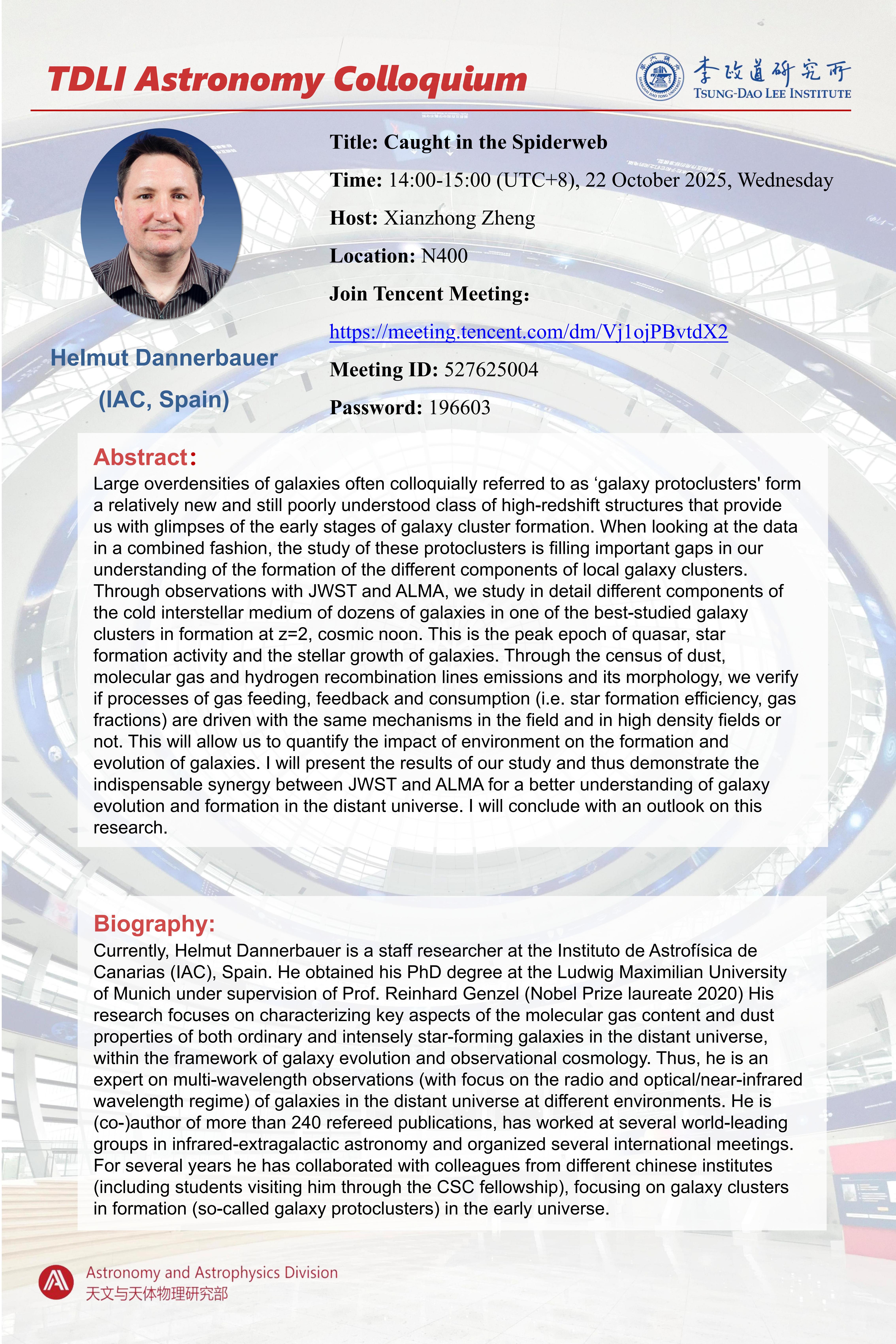
Currently, Helmut Dannerbauer is a staff researcher at the Instituto de Astrofísica de Canarias (IAC), Spain. He obtained his PhD degree at the Ludwig Maximilian University of Munich under supervision of Prof. Reinhard Genzel (Nobel Prize laureate 2020) His research focuses on characterizing key aspects of the molecular gas content and dust properties of both ordinary and intensely star-forming galaxies in the distant universe, within the framework of galaxy evolution and observational cosmology. Thus, he is an expert on multi-wavelength observations (with focus on the radio and optical/near-infrared wavelength regime) of galaxies in the distant universe at different environments. He is (co-)author of more than 240 refereed publications, has worked at several world-leading groups in infrared-extragalactic astronomy and organized several international meetings. For several years he has collaborated with colleagues from different chinese institutes (including students visiting him through the CSC fellowship), focusing on galaxy clusters in formation (so-called galaxy protoclusters) in the early universe.