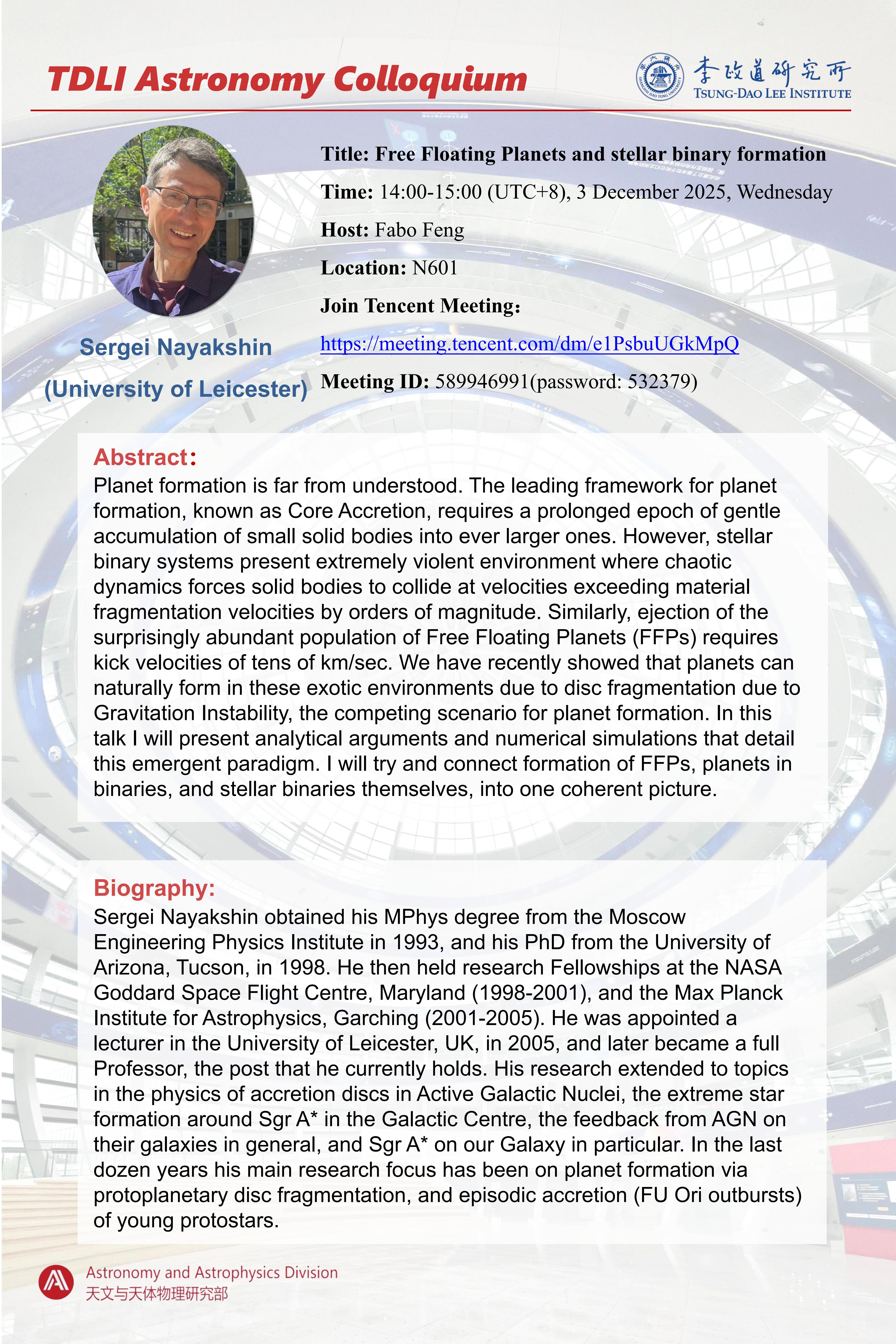
Free Floating Planets and stellar binary formation
by
Tsung-Dao Lee Institute/N6F-N601 - Meeting Room
Tsung-Dao Lee Institute
Host: Fabo Feng
Join Tencent Meeting:https://meeting.tencent.com/dm/e1PsbuUGkMpQ
Meeting ID: 589946991 (password: 532379)
Abstract:
Planet formation is far from understood. The leading framework for planet formation, known as Core Accretion, requires a prolonged epoch of gentle accumulation of small solid bodies into ever larger ones. However, stellar binary systems present extremely violent environment where chaotic dynamics forces solid bodies to collide at velocities exceeding material fragmentation velocities by orders of magnitude. Similarly, ejection of the surprisingly abundant population of Free Floating Planets (FFPs) requires kick velocities of tens of km/sec. We have recently showed that planets can naturally form in these exotic environments due to disc fragmentation due to Gravitation Instability, the competing scenario for planet formation. In this talk I will present analytical arguments and numerical simulations that detail this emergent paradigm. I will try and connect formation of FFPs, planets in binaries, and stellar binaries themselves, into one coherent picture.
Biography:
Sergei Nayakshin obtained his MPhys degree from the Moscow Engineering Physics Institute in 1993, and his PhD from the University of Arizona, Tucson, in 1998. He then held research Fellowships at the NASA Goddard Space Flight Centre, Maryland (1998-2001), and the Max Planck Institute for Astrophysics, Garching (2001-2005). He was appointed a lecturer in the University of Leicester, UK, in 2005, and later became a full Professor, the post that he currently holds. His research extended to topics in the physics of accretion discs in Active Galactic Nuclei, the extreme star formation around Sgr A* in the Galactic Centre, the feedback from AGN on their galaxies in general, and Sgr A* on our Galaxy in particular. In the last dozen years his main research focus has been on planet formation via protoplanetary disc fragmentation, and episodic accretion (FU Ori outbursts) of young protostars.