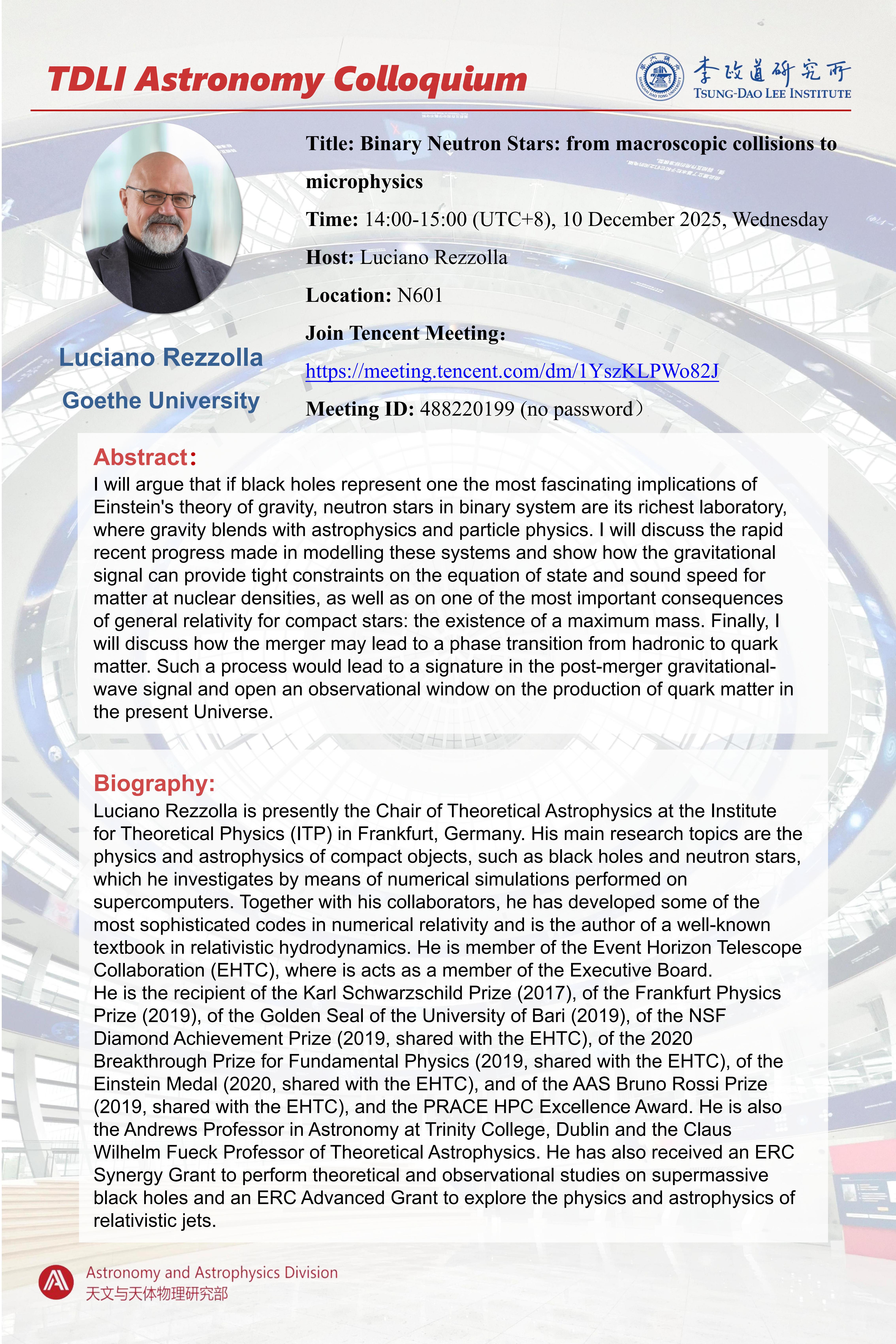
Binary Neutron Stars: from macroscopic collisions to microphysics
by
Tsung-Dao Lee Institute/N6F-N601 - Meeting Room
Tsung-Dao Lee Institute
Host: Yosuke Mizuno
Join Tencent Meeting:https://meeting.tencent.com/dm/1YszKLPWo82J
Meeting ID: 488220199 (no password)
Abstract:
I will argue that if black holes represent one the most fascinating implications of Einstein's theory of gravity, neutron stars in binary system are its richest laboratory, where gravity blends with astrophysics and particle physics. I will discuss the rapid recent progress made in modelling these systems and show how the gravitational signal can provide tight constraints on the equation of state and sound speed for matter at nuclear densities, as well as on one of the most important consequences of general relativity for compact stars: the existence of a maximum mass. Finally, I will discuss how the merger may lead to a phase transition from hadronic to quark matter. Such a process would lead to a signature in the post-merger gravitational-wave signal and open an observational window on the production of quark matter in the present Universe.
Biography:
Luciano Rezzolla is presently the Chair of Theoretical Astrophysics at the Institute for Theoretical Physics (ITP) in Frankfurt, Germany. His main research topics are the physics and astrophysics of compact objects, such as black holes and neutron stars, which he investigates by means of numerical simulations performed on supercomputers. Together with his collaborators, he has developed some of the most sophisticated codes in numerical relativity and is the author of a well-known textbook in relativistic hydrodynamics. He is member of the Event Horizon Telescope Collaboration (EHTC), where is acts as a member of the Executive Board.
He is the recipient of the Karl Schwarzschild Prize (2017), of the Frankfurt Physics Prize (2019), of the Golden Seal of the University of Bari (2019), of the NSF Diamond Achievement Prize (2019, shared with the EHTC), of the 2020 Breakthrough Prize for Fundamental Physics (2019, shared with the EHTC), of the Einstein Medal (2020, shared with the EHTC), and of the AAS Bruno Rossi Prize (2019, shared with the EHTC), and the PRACE HPC Excellence Award. He is also the Andrews Professor in Astronomy at Trinity College, Dublin and the Claus Wilhelm Fueck Professor of Theoretical Astrophysics. He has also received an ERC Synergy Grant to perform theoretical and observational studies on supermassive black holes and an ERC Advanced Grant to explore the physics and astrophysics of relativistic jets.