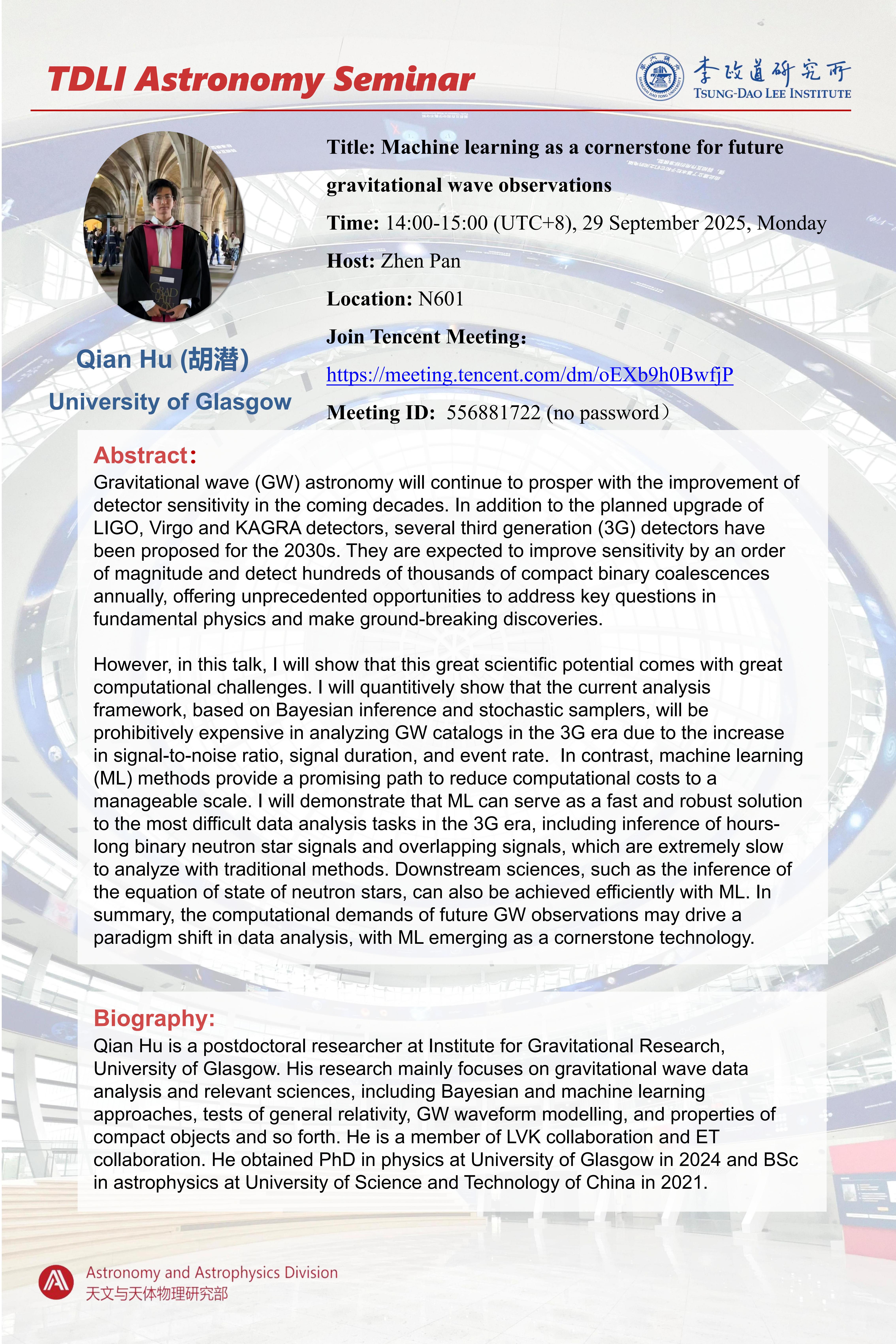
Machine learning as a cornerstone for future gravitational wave observations
by
Tsung-Dao Lee Institute/N6F-N601 - Meeting Room
Tsung-Dao Lee Institute
Host: Zhen Pan
Join Tencent Meeting:
https://meeting.tencent.com/dm/oEXb9h0BwfjP
Meeting ID: 556881722 (no password)
Abstract:
Gravitational wave (GW) astronomy will continue to prosper with the improvement of detector sensitivity in the coming decades. In addition to the planned upgrade of LIGO, Virgo and KAGRA detectors, several third generation (3G) detectors have been proposed for the 2030s. They are expected to improve sensitivity by an order of magnitude and detect hundreds of thousands of compact binary coalescences annually, offering unprecedented opportunities to address key questions in fundamental physics and make ground-breaking discoveries. However, in this talk, I will show that this great scientific potential comes with great computational challenges. I will quantitively show that the current analysis framework, based on Bayesian inference and stochastic samplers, will be prohibitively expensive in analyzing GW catalogs in the 3G era due to the increase in signal-to-noise ratio, signal duration, and event rate. In contrast, machine learning (ML) methods provide a promising path to reduce computational costs to a manageable scale. I will demonstrate that ML can serve as a fast and robust solution to the most difficult data analysis tasks in the 3G era, including inference of hours?long binary neutron star signals and overlapping signals, which are extremely slow to analyze with traditional methods. Downstream sciences, such as the inference of the equation of state of neutron stars, can also be achieved efficiently with ML. In summary, the computational demands of future GW observations may drive a paradigm shift in data analysis, with ML emerging as a cornerstone technology.
Biography:
Qian Hu is a postdoctoral researcher at Institute for Gravitational Research, University of Glasgow. His research mainly focuses on gravitational wave data analysis and relevant sciences, including Bayesian and machine learning approaches, tests of general relativity, GW waveform modelling, and properties of compact objects and so forth. He is a member of LVK collaboration and ET collaboration. He obtained PhD in physics at University of Glasgow in 2024 and BSc in astrophysics at University of Science and Technology of China in 2021.