[2025-01-18] For better promotion of the events, the categories in this system will be adjusted. For details, please refer to the announcement of this system. The link is https://indico-tdli.sjtu.edu.cn/news/1-warm-reminder-on-adjusting-indico-tdli-categories-indico

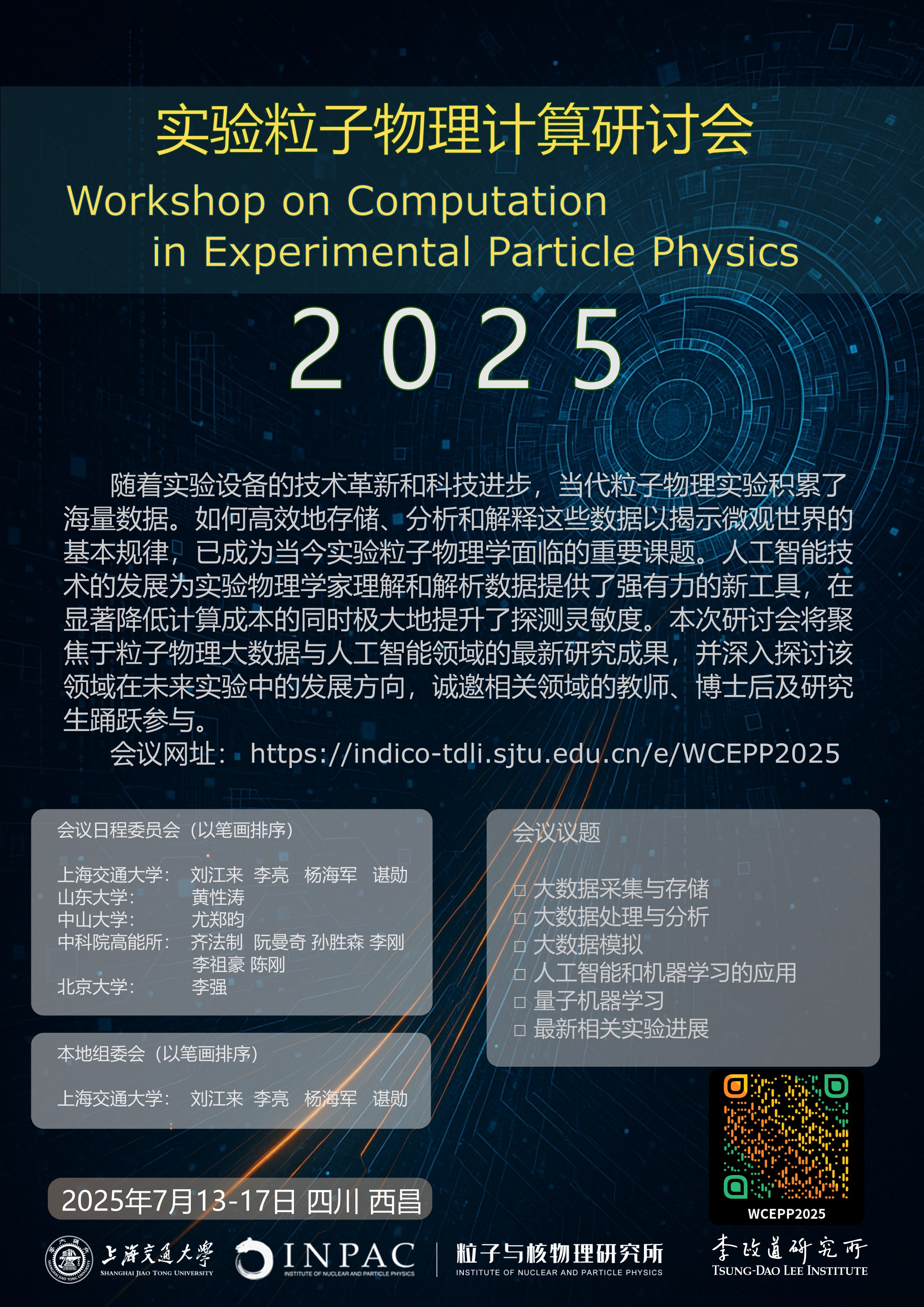
实验粒子物理计算研讨会(2025)

Asia/Shanghai
SJTU Xichang Center

SJTU Xichang Center

Description

粒子物理是一门深奥而令人着迷的学科,通过研究微观世界的基本构成粒子,我们可以更好地理解宇宙的本质。随着实验设备的技术革新和科技进步,当代粒子物理实验积累了海量数据。如何高效地存储、分析和解释这些数据以揭示微观世界的基本规律,已成为当今实验粒子物理学面临的重要课题。人工智能技术的发展为实验物理学家理解和解析数据提供了强有力的新工具,在显著降低计算成本的同时极大地提升了探测灵敏度。
为了促进领域内相关学者之间的交流,分享研究成果、思想和经验,共同探讨未来实验粒子物理研究中的大数据与人工智能的发展方向,我们将于2025年7月13日至17日在四川省凉山州西昌市上海交通大学西昌基地举办2025年实验粒子物理计算研讨会。13日报到,14日正式开始,16日参观锦屏地下实验室。诚邀相关领域的教师、博士后及研究生踊跃参与。注册和报告提交截止日期为2025年6月22日。

会议远程链接

2025714

https://meeting.tencent.com/dm/ZEMwy84Hgdd1

#腾讯会议:637-472-832

会议密码:123456

2025715

https://meeting.tencent.com/dm/w8XlOrdDDdlO

#腾讯会议:603-320-296

会议密码:123456

2025717

https://meeting.tencent.com/dm/uujgd7t3A9S8

#腾讯会议:782-286-371

会议密码:123456

本次会议收注册费,教师及博士后1500元,学生800元,食宿自理。
 

Participants
  • Baihong Zhou
  • Bingxuan Liu
  • bolun zhang
  • Chunxiu Liu
  • Fazhi QI
  • Gang Li
  • Jiahao Zhang
  • Jiamin Wang
  • Jingyan Shi
  • Junfeng Sun
  • Ke Li
  • Kun Wang
  • Lekang Jia
  • Liang 亮 Li 李
  • Linghui Wu
  • Manqi RUAN
  • Pengxuan 鹏轩 Zhu 朱
  • Qin Chang
  • qinghong zhang
  • ran han
  • Shengsen Sun
  • Shuihan Zhang
  • Shuopin Wen
  • Xiang Chen
  • xingze wang
  • Xu Wang
  • Yangu Li
  • Ye Yuan
  • Yinhui Wu
  • yongzhao Sun
  • Yueling Yang
  • Yuexin Wang
  • Zhaoyang Yuan
  • Zhengde ZHANG
  • Ziyan Deng
  • Zuhao LI
  • 亮亮 王
  • 刚 陈
  • 勋 谌
  • 叙 张
  • 尹 丽巧
  • 建琴 许
  • 朝义 渠
  • 楚铖 潘
  • 琪 严
  • 瑞(Rui) 张(Zhang)
  • 皓 胡
  • 科军 朱
  • 筱璐 季
  • 耀东 程
  • 迪 张
  • 铖禹 杨
  • 雨长 孙
    • 14:00 18:00
      注册
    • 08:50 09:00
      开始
    • 09:00 10:20
      新技术与物理
      • 09:00
        AMS最新物理结果 40m

        AMS最新物理结果

        Speaker: Zuhao LI (中国科学院高能物理研究所)
      • 09:40
        Final 0.12 ppm Measurement from the Muon g-2 Experiment at Fermilab 40m

        The Fermilab Muon g-2 experiment has now completed its analysis of the entire Run 1–6 data set, reaching a final precision of 0.12 ppm on the muon anomalous magnetic moment . I will outline the key experimental advances that enabled this result: refined magnetic-field mapping, upgraded beam dynamics modeling, improved calorimeter calibration, optimized offline production workflows and comprehensive control of systematic uncertainties. A brief comparison with current Standard-Model predictions will be given, but the focus will remain on experimental results and the path forward for next-generation precision muon measurements.

        Speaker: Prof. Liang Li (Shanghai Jiao Tong University)
    • 10:20 10:50
      茶歇 30m
    • 10:50 12:00
      人工智能和机器学习的应用
      • 10:50
        A Transformer-based Jet Flavour Tagger at ATLAS 40m

        ATLAS最近发布了一个基于 Transformer架构的味标记算法,性能相较于上一代算法有了质的提升。此外,新算法还带了范式改变,直接利用喷注与径迹信息作为输入而不依赖于中间算法。校准结果显示新算法在数据中的效能与模拟类似,预期将为新一轮的物理分析结果产生重大影响。该报告将会详细介绍此算法的技术细节以及开发过程背后的经验得失,同时也会对未来标记算法的发展做出展望。

        Speaker: Bingxuan Liu (Shenzhen Campus of Sun Yat-sen University)
      • 11:30
        Advancing fully hadronic final state searches at the LHC: The case of HH(4b) 30m

        We show that fully hadronic final state searches at the LHC—exemplified by the $HH(4b)$ flagship analysis—can achieve a 5–10× improvement in sensitivity by transitioning from jet-based methods to jet-free, event-level analysis powered by large-scale AI models. Existing approaches depend heavily on jet tagging, whose performance has plateaued despite sophisticated ML developments. Our strategy trains a universal classifier to distinguish $X \to Y_1Y_2 \to b\bar{b}b\bar{b}$ signals from QCD and $t\bar{t}$ backgrounds over a wide mass range, while estimating $Y_{1,2}$ masses via multiclass classification. The method can be validated with $ZZ(4b)$ events and is fully calibratable. We argue that this unified, event-level, AI-driven framework sets a new paradigm for sensitivity enhancement, offering a powerful path toward precision Higgs self-coupling measurements and other key physics goals at the LHC.

        Speaker: Congqiao Li (Peking University)
    • 12:00 13:30
      午休
    • 13:30 15:10
      人工智能和机器学习的应用
      • 13:30
        A holistic approach of event reconstruction and physics analysis 40m

        Identification plays a central role in experimental particle physics, either identifying different physics objects or distinguishing signal events from backgrounds.
        Benefit from the rapid development of AI tools, we propose a holistic approach for the identification task.
        This approach takes all the reconstructable information as input and infers the relevant categories using sufficiently trained AI tools.
        At CEPC, a proposed Higgs factory, this approach leads to unprecedented performance in jet identification and could boost the anticipated precisions of critical Higgs measurements by roughly three times.

        The relevant limitations and requirements of this methodology will also be discussed

        Speaker: Manqi RUAN (Institute of High Energy Physics, Beijing, China)
      • 14:10
        正负电子希格斯工厂上一一对应的粒子流重建 30m

        粒子流重建是目前高能对撞机实验上广泛采用的重建方法,其终极目标是实现重建前后粒子的一一对应性并高效鉴别其种类。但在实际实验中,如探测器有限的接收度和空间颗粒度、重建算法的不完美等因素往往会打破这种一一对应性。本报告将以 CEPC 为例,介绍未来正负电子希格斯工厂上关于一一对应性粒子流重建性能的研究,通过使用 truth link 对重建粒子进行细致的分析和分类并结合机器学习技术,实现了假粒子的高效鉴别与去除,将双喷注末态希格斯玻色子的不变质量分辨率提升了15%。此外也同时实现了9种粒子的高效鉴别,对五种带电粒子(电子、$\mu$子、$\pi$介子、K介子、质子)和光子的鉴别效率可高达97%以上,对三种中性强子(长寿命中性K介子、中子、反中子)的借鉴效率也可达到75%-80%,极大拓展了传统粒子鉴别的类别。

        Speaker: Yuexin Wang (IHEP, CAS)
      • 14:40
        Search for Long-lived Particles at Future Lepton Colliders Using Leptons and Jets 30m

        Long-lived particles (LLPs) have a clear signature of physics beyond the Standard Model (BSM), characterized by displaced vertex or decay lengths corresponding to lifetimes of nanoseconds or longer. Lepton colliders provide a clean environment for LLP searches. This study employs full simulation data to investigate LLPs produced in Higgs decays via the process e+e−→ZH, where each LLP decays into visible final-state particles such as jets, charged leptons, or neutrinos.
        This talk focuses on the 2‑lepton channels, including both dielectron and dimuon final states, which benefit from low background and precise tracking. Additionally, sensitivity in the hadronic decay mode (LLP->jets) is further improved using machine learning techniques. By combining multiple decay channels, we demonstrate the enhanced potential for LLPs at future lepton colliders

        Speaker: Xiang Chen
    • 15:10 15:40
      茶歇 30m
    • 15:40 17:30
      大数据采集与存储
      • 15:40
        HERD科学数据管理与工作流系统 40m

        HERD是即将安装在我国空间站的大型高能宇宙线探测装置,运行以后每年将产生载荷在轨科学数据、运行数据、刻度与参数数据以及模拟、重建等各类复杂的数据,需要进行全流程高效的管理。本报告将介绍HERD科学数据管理与工作流系统,功能包括在在轨实验/模拟数据产生、传输、重建、归档等一系列的过程中对数据的状态和数据处理过程进行跟踪和记录。该系统还采用工作流和作业自动提交的方式实现模拟数据以及数据产品的自动生成,以满足科学研究人员对数据高效利用和共享的需求,同时也可为其它同类型的实验提供参考。

        Speaker: 耀东 程 (中国科学院高能物理研究所(IHEP))
      • 16:20
        Data analysis and Software at LHAASO 40m

        This report focuses on the data analysis software and data processing progress of the Large High Altitude Air Shower Observatory (LHAASO). The annual data processing scale of LHAASO reaches 12 PB. By simulating air showers with CORSIKA, simulating detector responses with Geant4, and leveraging the ANYSW cross-platform compilation environment (integrating toolchains such as ROOT and Geant4), efficient data reconstruction and in-depth analysis are achieved. Based on existing data, several breakthrough results have been obtained. In addition, LHAASO is advancing an intelligent transformation project, aiming to build an intelligent data processing workflow to further enhance the observation efficiency and scientific discovery capabilities.

        Speaker: 尹 丽巧 (中国科学院高能物理研究所)
      • 17:00
        一种实时智能数据质量监测方案的研究与实现 30m

        针对高能物理实验数据质量监测的共性需求,本文突破传统监测方法的局限,设计并研发了一种通用的智能监测体系。首先,针对不同高能物理实验在线监测系统重复设计的痛点,提出并实现了一种基于ROOT的通用数据质量监测方案。通过标准化接口规范,系统能够快速适配不同实验平台,显著提高了开发效率与可复用性。同时,为确保大规模系统下的实时响应能力,提出了基于级联配置和“HistMaster”分布式处理架构的部署策略,并通过并行计算优化,实现了系统的高效部署与稳定运行。经多场景验证,该方案在不同实验环境下均表现出良好的适用性与可靠性。
        此外,针对同时监测上万张直方图的复杂场景,本文结合先进的智能技术,提出了一种基于机器学习的实时异常检测方法,构建了“特征提取-模型训练-模型评估优化-在线部署”的完整技术链条。实验验证表明,该方法在万级直方图并发监测场景下,将异常检测耗时压缩至秒量级,且检测精确率较传统方法显著提升。该方案已成功部署应用于实际实验,为高能物理实验数据质量监测提供了可推广的实时异常检测范式。
        目前,本文已基于JUNO-SPMT数据集完成了系统框架的设计与关键技术实现,相关成果不仅为JUNO实验提供了技术支持,也为其他高能物理实验的数据质量监测提供了可复用的解决方案,具有广泛的推广价值。

        Speaker: Shuihan Zhang (IHEP)
    • 09:00 12:00
      大数据采集与存储
      • 09:00
        高能物理科学数据中心介绍 40m

        国家高能物理科学数据中心是科技部首批认定的20个国家科学数据中心之一,致力于为全球科研人员及学生提供高能物理、中子科学、光子科学、天体物理等基础研究及多学科交叉研究的数据支撑服务。作为我国高能物理领域的重要科研基础设施,数据中心已构建起国际领先的科研数据平台,具备60PB级存储容量、数万CPU核计算能力、万兆国际网络带宽等先进的信息化支撑条件,服务全球专业用户近万人。
        数据中心紧密围绕国家重大科技基础设施和重点科研项目的需求,系统性地开展科学数据的汇交、整合与共享工作。目前,中心已汇聚来自大亚湾中微子实验、江门中微子实验(JUNO)、北京谱仪(BESIII)、欧洲核子研究中心ATLAS/CMS/LHCb等国际大型实验项目的海量科研数据,覆盖高能物理、中子科学、光子科学、天体物理等多个前沿研究领域。同时,中心还为中国散裂中子源(CSNS)、硬X射线调制望远镜(HXMT)、大型高海拔宇宙线观测站(LHAASO)等国家重大科技基础设施,以及爱因斯坦探针(EP)卫星等空间科学项目提供专业的数据汇交与管理服务。
        为充分挖掘科学数据价值,数据中心自主研发了系列专业数据处理分析软件,并创新性地将人工智能技术应用于高能物理研究。中心打造的Dr.Sai大模型及相关智能体技术,为高能物理与人工智能的交叉创新提供了重要技术支撑。
        未来,国家高能物理科学数据中心将继续秉持"开放共享、服务创新"的理念,围绕国家重大战略需求,持续优化数据服务体系,推动科学数据的高效利用,为高能物理领域的科研突破和创新型国家建设提供坚实的数据基础支撑。

        Speaker: 皓 胡 (中国科学院高能物理研究所)
      • 09:40
        阿尔法磁谱仪(AMS)的事例重建和离线软件开发 40m

        位于国际空间站上的阿尔法磁谱仪(AMS),是目前世界上唯一的大型精密太空粒子磁谱仪,致力于精确测量宇宙线中的各种带电粒子与反粒子,从而对暗物质、反物质、以及宇宙线的起源进行研究。自2011年开始运行,AMS已累计采集超过2300亿宇宙线事例。AMS探测器长期运行在严苛的太空环境中,本报告将介绍AMS独特的事例重建(包括模拟、标定、重建)方法用于高精度的事例重建。此外,AMS的离线软件基于英特尔编译器开发,已迭代至支持Intel openAPI DPC++/C++编译环境。该系统具备高效的多线程处理能力,在模拟与重建上实现了事件级的并行化,支撑大规模、高电荷高能量的宇宙线数据的高性能处理需求。

        Speaker: 琪 严 (中国科学院高能物理研究所)
      • 10:20
        茶歇 30m
      • 10:50
        JUNO DAQ的设计与实现 40m

        江门中微子实验(JUNO)是一个地下中微子观测站,已经完成建设,正在进行最后的液闪置换工作,即将转入正式的物理运行。JUNO的中心探测器安装了17612个20英寸的光电倍增管(LPMT),采用高速高分辨率的波形数字化技术来探测光子。为了增强探测能力,还在LPMT阵列的间隙中布置了25600个3 英寸的光电倍增管(SPMT)。此外,还有2400个LPMT被用于外围的水切伦科夫探测器,其主要功能是识别宇宙射线缪子并减少相关的本底噪声。JUNO的数据获取系统(DAQ)被设计用来收集每秒约50GB的原始数据流,对数据进行实时处理,包括在线数据组装和事例分类,最终将数据吞吐量压缩至每秒低于100MB。此次报告将介绍 JUNO DAQ 系统的架构设计和技术实现,以及软件开发和硬件部署的最新进展。

        Speaker: 筱璐 季 (中国科学院高能物理研究所)
      • 11:30
        面向CEPC的异构在线数据处理平台——RadarV3.0 30m

        在高能物理实验中,数据获取与在线数据处理扮演着重要的角色,能实现数据获取、重建与筛选,为后续精细物理重建和分析提供坚实的数据基础。本课题组研发的数据获取与在线数据处理平台——RADAR(heteRogeneous Architecture of Data Acquisition and pRocessing),经多轮迭代优化,已广泛应用于重大高能物理实验。基于RADAR V1.0和V2.0版本开发的系统,分别在LHASSO(高海拔宇宙线观测站实验)和JUNO(江门中微子实验)实验中稳定可靠运行。面对新一代实验项目如CEPC(环形正负电子对撞机实验)对在线数据处理能力的更高要求,课题组正致力于开发RADAR V3.0。本文将介绍RADAR V3.0的异构调度策略与资源管理机制,并深入探讨其未来发展方向,为未来高吞吐高带宽的新一代高能物理实验在线处理提供解决思路。

        Speaker: 叙 张
    • 12:00 13:30
      午休
    • 13:30 15:15
      人工智能和机器学习的应用
      • 13:30
        Transformer Architectures in Jet Tagging from Foundations to Frontiers 40m

        Jet tagging is essential for identifying hadronic decays of boosted particles at collider experiments. Transformer-based deep learning models have become state-of-the-art due to their ability to capture complex particle interactions. This talk reviews the development of Transformer architectures in jet tagging, from Particle Transformer to our More Interaction Particle Transformer (MIParT), which improves interaction modeling with reduced complexity. We highlight recent advances such as Lorentz-equivariant models (L-GATr), Interaction-Aware architectures (IAFormer), and new directions including foundation models (HEP-JEPA), auxiliary-task-enhanced transformers (GN2). We conclude with a discussion on the fundamental limits of jet tagging and future prospects for AI in collider physics.

        Speaker: Kun Wang (University of Shanghai for Science and Technology)
      • 14:10
        大模型在高能物理中的应用初探 40m

        本报告聚焦大模型在高能物理中的应用方法。以DeepSeek为切入点,作为国产模型,其推理能力强、生态开源且性价比高,在上海交大 “交我算” 等高校智算平台实现国产化部署。可通过提示词工程辅助文献阅读、生成研究思路、编程及可视化,结合 RAG 技术、微调策略等定制方法提升其在高能物理领域适配性。大模型应用实例方面,中科院高能物理所 XIWU 模型、OMAI 运维助手及 CERN 的 AccGPT 等案例,都展示了大语言模型在高能物理领域文献分析、运维支持等场景的实践价值。

        Speaker: xingze wang (Shanghai Jiao Tong University Network & Information Center)
      • 14:50
        Machine Learning for Parton-Level Studies of Quantum Entanglement Using pp→ττ 25m

        Quantum entanglement is a hallmark feature of quantum mechanics, manifesting as correlations between subsystems that cannot be fully described without one another, regardless of spatial separation. While entanglement has been observed in processes such as 𝑝𝑝→𝑡𝑡¯ and thoroughly analyzed in Higgs decay channels (𝐻→𝑉𝑉) at the Large Hadron Collider (LHC), it remains comparatively underexplored in the 𝑝𝑝→𝜏𝜏 system. In this study, we adapt OmniLearn, a foundational model for solving all jet physics tasks, to reconstruct the neutrino information in the final state of 𝑝𝑝→𝜏𝜏 system, which is an essential step toward probing quantum entanglement in this channel. Good neutrino reconstruction has reached now, which is the key to the following steps in the reconstruction level study.

        Speaker: Baihong Zhou (TDLI, SJTU)
    • 15:15 15:45
      茶歇 30m
    • 15:45 16:25
      新技术与物理
      • 15:45
        Quantum machine learning algorithms in High Energy Physics 40m

        Quantum computing has arisen as a transformative approach capable of addressing complex computational challenges beyond the reach of classical systems. In recent years, significant attention has turned to leveraging quantum algorithms across diverse domains, particularly High Energy Physics (HEP). This presentation offers a comprehensive survey of quantum machine learning techniques and their relevance to HEP investigations. We will outline the core concepts of quantum computation, such as superposition, entanglement, and quantum logic operations. Subsequently, we will examine specialised quantum algorithms, including quantum-enhanced support vector machines and otghers, emphasizing their prospective role in tackling demanding computational tasks in HEP research.

        Speaker: 瑞(Rui) 张(Zhang) (南京大学(Nanjing University))
    • 16:25 17:35
      大数据处理与分析
      • 16:25
        Putting it all together: what we can learn from BSM global fits? 40m

        Understanding the full implications of experimental searches
        requires the interpretation of the experimental results in the context
        of many more theoretical models than are currently explored at the
        time of publication. Here I briefly introduce the GAMBIT framework and its ColliderBit module, and show our upcoming fit results of the full LHC Run II data interpreted in EWMSSM parameter space.

        Speaker: Pengxuan Zhu (University of Adelaide)
      • 17:05
        Global Track Reconstruction for HERD Experiment 30m

        The High Energy cosmic-Radiation Detection (HERD) facility is planned to be operational on China Space Station (CSS) starting from 2028, with a projected duration of approximately 10 years. With the high accuracy silicon charge detector (SCD) and silicon tracker (STK) forming a compact structure, HERD is capable to provide charge and direction measurement from the trajectory measurement of charged cosmic rays. A cellular automata based track reconstruction algorithm is developed and validated on HERD Monte Carlo simulation data. The efficiency of this algorithm reaches >93% for 100 GeV proton, helium and carbon events while keeping low fake rate <2%. Meanwhile, a complete realization of silicon digitalization and calibration procedure is reported.

        Speaker: 朝义 渠 (山东高等技术研究院)
    • 08:30 17:30
      锦屏地下实验室参观
    • 09:00 11:40
      人工智能和机器学习的应用
      • 09:00
        Dr. Sai物理分析智能体系统 40m

        自ChatGPT等大语言模型普及以来,AI作为新型生产工具已逐步深度融入人类生产活动。当前基于大语言模型的智能体可自主规划、调用工具和一定程度解释结果,成为近年来的热点领域。高能物理物理分析存在数据处理、文本解析等AI适配的固定步骤,同时具有分析流程复杂、需要专业知识等领域特点,成为AI4Science的一个典型场景。基于此,我们开发了用于BESIII物理分析的Dr.Sai多智能体系统:通过将复杂任务拆解为子任务序列,由数个专家型智能体协同执行算法生成、作业脚本构建与提交、结果可视化等核心环节。该系统已初步实现物理分析数据处理的自动化,未来将聚焦人机交互优化与数据驱动的模型能力增强,持续提升复杂科研任务的执行效率。

        Speaker: bolun zhang (IHEP)
      • 09:40
        PandaX的文档库智能问答系统 40m

        本报告介绍了为PandaX暗物质实验研发的智能文档问答系统。该系统整合开源RAG框架与商业大语言模型API,构建了覆盖arXiv数据库近30年"氙探测器"(xenon detector)领域文献的专业知识库。通过PDF文本提取、嵌入向量化处理建立语义检索数据库,并开发了前后端交互平台。用户可通过自然语言提问,系统自动定位相关文档片段,经大语言模型生成基于专业知识的答案。该系统显著提升了PandaX合作组获取实验文献的效率和准确性,为相关研究提供了智能化文档支持。

        Speaker: Dr 勋 谌 (SJTU)
      • 10:20
        茶歇 30m
      • 10:50
        基于深度学习的PMT探测器暗噪声计数率实时异常监测系统 25m

        JUNO实验采用光电倍增管(PMT)阵列进行中微子信号探测。在正常工作状态下,PMT的暗计数率保持相对稳定。当PMT出现异常发光现象时,会诱发周边PMT产生响应,导致虚假信号(本底噪声)的生成。为保障实验数据的可靠性,监测系统会实时检测各PMT的工作状态,一旦发现暗计数率异常,将立即关闭异常PMT,以避免其对周边探测单元造成干扰。
        因此针对这一需求开发了一套融合时空特征的实时异常检测系统。该系统通过整合图神经网络(GNN)与长短期记忆网络(LSTM)的混合架构,实现了对PMT暗噪声计数率(DCR)的精准监测与异常预警。训练阶段首先构建时空协同的统一数据结构,引入通道级百分位点统计量替代单一阈值;随后通过KD树空间索引实现高效邻域查询,支持距离阈值与K近邻两种拓扑构建方法;最终设计LSTM-GNN混合自动编码器模型。实时检测模块采用双缓存流式处理机制:设计动态数据接口支持分钟级延迟处理,通过标准化的数据管道实时获取并处理PMT数据;创新性引入通道自适应阈值机制,结合历史百分位分布动态调整判定阈值。
        该系统在保障时间完整性的前提下实现分钟级延迟响应,目前系统还在测试阶段,准备作为JUNO监测系统的子系统投入试运行。本研究提出的时空特征融合框架和轻量化实时处理算法,为大型粒子探测器监测提供了创新解决方案。

        Speaker: Yinhui Wu (中国科学院高能物理研究所)
    • 11:40 11:50
      总结