12th International Workshop on Charm Physics (CHARM 2025)
Tsung-Dao Lee Institute
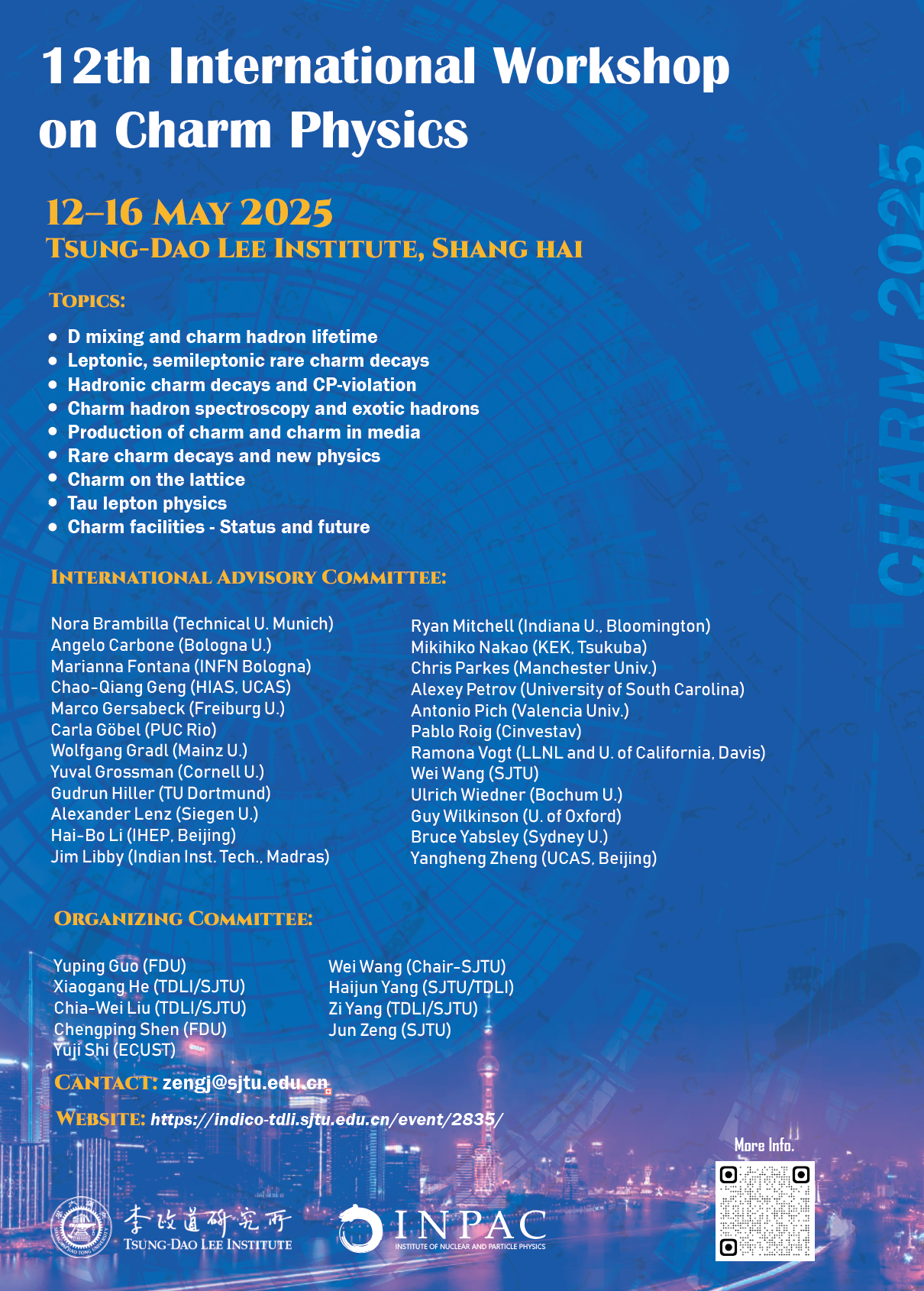
The 12th International Workshop on Charm Physics (CHARM 2025) will take place in Shanghai, China, from May 12 to 16, 2025. On-site registration is scheduled for May 11 or before 9:00 am on May 12. This event is hosted by the Tsung-Dao Lee Institute / Shanghai Jiao Tong University, located at 1 Lisuo Road, Pudong New Area, Shanghai. Website: https://indico-tdli.sjtu.edu.cn/event/2835/ .
The purpose of the CHARM 2025 Workshop is to bring together theorists and experimentalists working in charm physics to discuss recent results in this area, including the impact on and from theory as well as projections for results to be expected from upcoming experimental facilities.
This year's conference will cover the following topics:
- D mixing and charm hadron lifetime
- Leptonic, semileptonic rare charm decays
- Hadronic charm decays and CP-violation
- Charm hadron spectroscopy and exotic hadrons
- Production of charm and charm in media
- Rare charm decays and new physics
- Charm on the lattice
- Tau lepton physics
- Charm facilities - Status and future
The registration fee (including meals, banquets, and coffee breaks) is:
Before 25th April: ¥2300 RMB (approximately 300 Euros) for falculties and post-doctors, and ¥1500 RMB (apprxomately 200 Euros) for students.
After 25th April: ¥2600 RMB (approximately 350 Euros) for falculties and post-doctors, and ¥1900 RMB (apprxomately 250 Euros) for students.
Talks will be live-streamed through the Koushare platform by default.
For plenary talk and parallel session A, the link is
https://www.koushare.com/live/details/42177
For parallel session B on Monday, Tuesday, and Thursday, the links are given in order:
https://www.koushare.com/live/details/42688
https://www.koushare.com/live/details/42689
https://www.koushare.com/live/details/42690
Confirmed plenary speakers
| Luciano Maiani (Rome) | Nora Brambilla (Munich) |
| Stephen Olsen (Beijing) | Yinghui Guan (Cincinnati) |
| Viljiami Leino (Mainz) | Fu-Sheng Yu (Lanzhou) |
| Feng-Kun Guo (Beijing) | Dominik Stefan Mitzel (CERN, LHCb) |
| Antonio Vairo (Munich) | Tommaso Pajero (CERN) |
| Xiangpeng Wang (Munich) | Bo Zheng (Hengyang) |
| Lu Zehui (Beijing) | Jiajia Qin (Hengyang) |
| Yuping Guo (Shanghai) | Xiaorong Zhou (Hefei) |
| Ulf-G. Meißner (Bonn/Jülich) | Sen Jia (Nanjing) |
| Long-Ke Li (Changsha) | Andreas Juettner (Soton) |
| Emanuele Santovetti (Rome) | Blazenka Melic (Zagreb) |
| Yanxi Zhang (Beijing) | Roberto Ribatti (EPFL) |
| Qi-An Zhang (Beijing) | Seema Bahinipati (Bhubaneswar) |
| Ruoyu Zhang (Lanzhou) | Cong Geng (Guangzhou) |
| Antonio Rodríguez-Sánchez (Valencia) | Hui Li (Beijing) |
| Cheng-Wei Chiang (Taipei) |
Plenary talks will be by invitation only - please submit an abstract to apply for a parallel talk.
The 2D QR code for the conference wechat group is:

-
-
09:00
→
09:15
Welcome Tsung-Dao Lee Institute/S5F-S500 - Lecture Hall
Tsung-Dao Lee Institute/S5F-S500 - Lecture Hall
Tsung-Dao Lee Institute
200Convener: Xiao-Gang He-
09:00
Welcome to SJTU/TDLI 15m
-
09:00
-
09:15
→
10:00
Opening Session Tsung-Dao Lee Institute/S5F-S500 - Lecture Hall
Tsung-Dao Lee Institute/S5F-S500 - Lecture Hall
Tsung-Dao Lee Institute
200Convener: Xiao-Gang He-
09:15
The rise of the Standard Theory: 50 years after J/\Psi discovery 45mSpeaker: Prof. Luciano Maiani
-
09:15
-
10:00
→
10:40
Conference Photo and Coffee break
-
10:40
→
12:25
D mixing and lifetime Tsung-Dao Lee Institute/S5F-S500 - Lecture Hall
Tsung-Dao Lee Institute/S5F-S500 - Lecture Hall
Tsung-Dao Lee Institute
200Convener: Wolfgang Gradl (Johannes Gutenberg University Mainz)-
10:40
D-meson mixing and charmed hadron lifetime at LHCb 35m Tsung-Dao Lee Institute/S5F-S500 - Lecture Hall
Tsung-Dao Lee Institute/S5F-S500 - Lecture Hall
Tsung-Dao Lee Institute
200Speaker: Roberto Ribatti (École polytechnique fédérale de Lausanne (EPFL)) -
11:15
Exploring Charm Quark Dynamics: Lifetimes and Mixing Phenomena 35m Tsung-Dao Lee Institute/S5F-S500 - Lecture Hall
Tsung-Dao Lee Institute/S5F-S500 - Lecture Hall
Tsung-Dao Lee Institute
200In this talk, we explore the dynamics of charm quarks through two key observables: charmed hadron lifetimes and neutral D-meson mixing. For lifetimes, we review the application of the Heavy Quark Expansion (HQE) to charm hadrons, examining recent theoretical efforts to quantify the convergence of the expansion at the charm scale, including the impact of higher-dimensional operators and subleading corrections and discuss limitations due to the relatively low charm mass scale. We then turn to the phenomenon of D-meson mixing, where long-distance contributions dominate and challenge the theory.
We explore the long-distance contributions arising from nonlocal QCD condensates. Our results demonstrate an improvement in the predicted values of the D0−D0 mixing parameter by more then an order of magnitude, providing insights into the role of nonperturbative QCD dynamics in the charm sector.
Speaker: Prof. Blazenka Melic (Rudjer Boskovic Institute Zagreb) -
11:50
D-meson mixing and charmed hadron lifetime with Belle and Belle II 35m Tsung-Dao Lee Institute/S5F-S500 - Lecture Hall
Tsung-Dao Lee Institute/S5F-S500 - Lecture Hall
Tsung-Dao Lee Institute
200Speaker: 颖慧/Yinghui 管/Guan
-
10:40
-
12:25
→
14:00
Lunch Ground-floor canteen
Ground-floor canteen
Tsung-Dao Lee Institute
Ground-floor canteen -
14:00
→
15:45
CP and Charm Decays Tsung-Dao Lee Institute/S5F-S500 - Lecture Hall
Tsung-Dao Lee Institute/S5F-S500 - Lecture Hall
Tsung-Dao Lee Institute
200Convener: XIAOYAN SHEN (IHEP, CAS)-
14:00
CP and CPT measurements at a tau-charm factory 35mSpeaker: Stephen Lars Olsen
-
14:35
Hadronic decays of charmed mesons and CP violation 35m
In this talk I'll give an overview of the two-body decays of charmed mesons
and their CP violation. Recent developments in $D\to VP$ and $VV$ decays
are discussed. Attention is paid to the enigmas occurred in recent measurements
of $D\to VV$. The long-distance penguin, which is the key ingredient responsible for direct CP violation in $D\to PP$ and $VP$, is emphasized and elaborated on.Speaker: Prof. Cheng-Wei Chiang (National Taiwan University) -
15:10
(Semi-)leptonic decays of charmed mesons at BESIII 35mSpeaker: Bo Zheng (University of South China)
-
14:00
-
15:45
→
16:15
Coffee Break
-
16:15
→
18:10
Parallel I: A Tsung-Dao Lee Institute/S5F-S500 - Lecture Hall
Tsung-Dao Lee Institute/S5F-S500 - Lecture Hall
Tsung-Dao Lee Institute
200Conveners: Long-Bin Chen (Guangzhou University), Yuji Shi (华东理工大学)-
16:15
Radiative two-pion tau decay and its impact on muon g-2 20m
In this talk I will focus on the tau -> pi pi gamma nu process. Special attention will be paid to the triple-product asymmetry arising from this decay channel. Anomalous rho-omega-pi type of interacting vertices, together with the ones with even parity, are simultaneously included in our calculation. The branching fraction of the radiative two-pion tau decay is predicted to be around 10^-4 even with the photon energy cutoff at 300 MeV. Invariant-mass spectra of the pi-pi and pi-gamma systems are predicted as well, which can probe different light hadron resonance dynamics. An interesting triple-product asymmetry, constructed with the momenta of the final-state particles, is revealed in our study. I also plan to discuss the impact of the isospin-breaking corrections from this radiative two-pion tau decay to the muon g-2.
Speaker: Zhi-Hui Guo (Hebei Normal University) -
16:35
CP asymmetries in $\tau \to K_S \pi \nu_\tau$ decays 20m
The $\tau$ lepton is the only known lepton massive enough to decay into hadrons. Besides serving as a clean laboratory for studying various low-energy aspects of the strong interactions, the hadronic $\tau$ decays may also allow us to explore CP-violating effects both within and beyond the SM. In this talk, I will discuss the CP asymmetries in $\tau \to K_S \pi \nu_\tau$ decays, which arise due to the CP violation in $K^0-\bar{K}^0$ mixing within the SM. Within a generic effective field theory framework, I will then discuss the CP asymmetries induced by the beyond-the-SM four-fermion operators up to dimension-6. Interesting observations as well as the correlations among different observables will be presented. These studies are relevant to the Belle II experiment as well as the proposed Tera-Z and STCF facilities.
Speaker: Xin-Qiang Li (Central China Normal Univerisy) -
16:55
Semileptonic Charm Decay at N3LO in perturbative QCD 20m
Semileptonic decays of charm-flavored hadrons, particularly D mesons, offer important avenues to address key questions in heavy-flavor physics, such as the long-standing discrepancy between inclusive and exclusive determinations of CKM matrix elements involving charm quarks. Precision measurements of semileptonic D-meson decays demand equally accurate theoretical predictions, for which QCD corrections, especially at the charm mass scale, are essential. In this talk, we present recently computed third-order perturbative QCD corrections (in the strong coupling) to semileptonic charm decays, covering both the inclusive decay width and several moments.
Speaker: Dr Long Chen (Shandong University) -
17:15
Three-channel $D\pi$ scattering from lattice QCD 20m
In this talk, I will present our recent follow-up lattice study building on our previous single-channel D\pi analysis (PRD 111, 014503 (2025)). In particular, I will discuss the two-pole structure of the D_0^*(2300) resonance.
Speaker: Mr Haobo Yan (Peking University) -
17:35
Flavor SU(3) symmetry for charmed baryons 15m
A large amount of data on hadronic two-body weak decays of antitriplet charmed baryons $T_{c\bar{3}}$ to an octet baryon $T_8$ and an octet or singlet pseudoscalar meson $P$, $T_{c\bar{3}} → T_8P$, have been measured. The SU(3) flavor symmetry has been applied to study these decays to obtain insights about weak interactions for charm physics. Combined with known data on decay, much information can be derived with SU(3) flavor symmetry. Furthermore, using SU(3) relations between different decay modes, one can give some predictions based on the new measurements which can be tested with the high luminosity experiments in the future.
Previous studies based on the flavor SU(3) symmetry predicted a large value close to one for $\alpha(\Lambda^+_c \rightarrow \Xi^0K^+)$ assuming real decay amplitudes which also lead to zero strong phase shifts. However, the new data now show the needs to have nonzero strong phase shifts, calling for a new theoretical understanding. In 2023, the BESIII collaboration has reported the first-time measurement of the decay asymmetry $\alpha(\Lambda^+_c \rightarrow \Xi^0K^+)=0.01\pm0.16\pm0.03$ and also a sizable phase shift of $δ_P − δ_S=−1.55 \pm 0.25$ or $1.59 \pm0.25$ between S- and P-wave amplitudes. This implies significant strong phase shifts in the decay amplitudes. The strong phases indicate the existence of rescattering or loop effects, which are challenging to calculate due to nonperturbative effects. By employing the flavor SU(3) symmetry and applying the Körner-Pati-Woo theorem to reduce the number of parameters, we find that the current data already allow us to obtain, for the first time, model-independent decay amplitudes and their strong phases. The establishment of the existence of sizable strong phases also opens a window for investigations into CP violations.Speaker: 畅/Chang 杨/Yang -
17:50
Non-leptonic weak decay of doubly charmed baryon 15m
The doubly charmed baryon, $\Xi_{cc}^{++}$, was first observed by
LHCb through the non-leptonic decay modes of $\Xi_{cc}^{++}\to\Lambda_{c}^{+}K^{-}\pi^{+}\pi^{+}$
and $\Xi_{c}^{+}\pi^{+}$. Following this discovery, researchers shifted
their focus to identifying other doubly charmed baryons, specifically
$\Xi_{cc}^{+}$ and $\Omega_{cc}^{+}$. In this study, we examine
the non-leptonic weak decays of doubly charmed baryons, denoted as
${\cal B}_{cc}\to{\cal B}_{c}P$, where ${\cal B}_{cc}$ represents
the doubly charmed baryons, specifically $(\Xi_{cc}^{++},\Xi_{cc}^{+},\Omega_{cc}^{+})$.
The notation ${\cal B}_{c}$ denotes the singly charmed baryons, specifically
$({\cal B}_{\bar{3}},{\cal B}_{6})$, while $P$ signifies the light
pseudoscalar. These terms are pertinent to the non-leptonic decay
modes under discussion. While the short-distance contributions can
be precisely estimated through theoretical calculations, addressing
the long-distance contributions for final-state-interaction effects
presents a significant challenge. In order to address this issue, we utilize the rescattering mechanism of final state interaction effects to compute the long-distance contributions. We initially derive the entire hadronic loop contributions for these two-body nonleptonic decays of doubly charmed baryons. In subsequent analyses, we are able to calculate relative strong phases. As a result, we can provide predictions for their decay asymmetry parameters and CP violations.
Furthermore, we employ experimental data from the LHCb collaboration, specifically the ratio $Br(\Xi_{cc}^{++}\to\Xi_{c}^{\prime+}\pi^{+})/Br(\Xi_{cc}^{++}\to\Xi_{c}^{+}\pi^{+})=(1.41\pm0.17\pm0.10)$, to ascertain the model parameters $\eta=0.9\pm0.2$. Consequently, we present the predictions of branching ratios and decay asymmetry parameters for 67 distinct decay processes and $CP$ violations for the singly Cabibbo suppressed channels.
This not only strengthens the validity of our theoretical predictions, but also provides a more comprehensive theoretical framework for the future identification of other doubly charmed baryons.Speaker: Xiao-Hui Hu (China university of mining and technology)
-
16:15
-
16:15
→
18:10
Parallel I: B Tsung-Dao Lee Institute/N4F-N400 - meeting room
Tsung-Dao Lee Institute/N4F-N400 - meeting room
Tsung-Dao Lee Institute
70Convener: Jianyong Zhang (IHEP)-
16:15
Exploring Nucleon Structure through radiative decay of J/\psi 20m
We propose to investigate short-range correlations (SRCs) in nuclei by studying sub-threshold photoproduction of ϕ particles in an electron-positron collision experiment. We present a direct experimental signature for SRCs, which is deemed achievable using the Beijing Spectrometer III (BESIII). The cross sections for sub-threshold production, as well as the likelihood of detection by BESIII, are calculated. These results underscore the substantial potential of BESIII in elucidating the fundamental physics behind the nuclear modification of parton distribution functions. This proposed experimental analysis of photon-nucleon interactions in electron-positron collisions represents uncharted territory, promising fresh prospects for applications in both particle and nuclear physics.
Speaker: 吉/Ji 徐/Xu (兰州大学) -
16:35
A dynamical link between $D^0-\bar{D}^0$ mixing and chiral symmetry breaking 20m
For charm mixing, it is known that the lowest order analysis in the operator product expansion (OPE) does not reproduce the experimental data, indicating the importance of power-suppressed corrections. In particular, contributions induced by quark condensates are discussed as possible sources of enhancement in the previous works. Those investigations generically imply that chiral symmetry breaking plays a crucial role in $D^0-\bar{D}^0$ mixing.
In this work, we discuss the Dyson-Schwinger approach to charm mixing. By using propagators for d and s quarks, we evaluate SU(3) breaking that originates from dynamical chiral symmetry breaking (DCSB). To this end, we adopt the parametrization of the quark propagator in the previous work, which accommodates color confinement and asymptotic freedom, in addition to DCSB. It is shown that, the order of magnitude for a mixing parameter ($x$) is comparable to the experimental data, leading to an improvement compared with the OPE analysis.
Speaker: Dr Hiroyuki Umeeda (Jilin University) -
16:55
Perturbative QCD Evidence for Spin-2 Particles in the Di-$J/\psi$ Resonances 20m
We extend the nonrelativistic QCD framework to explore the nature of the newly discovered di-$J/\psi$ resonances. Assuming them as either molecule-like states or tetraquarks, we calculated their hadroproduction cross sections at the LHC. We find that the observed resonances are most likely spin-2 particles, and there should exist their spin-0 counterparts near these resonances. The ratio of production cross sections of the observed resonances to the latent spin-0 ones are also presented, which might help to distinguish molecule-like states from tetraquarks.
Speaker: Hong-Fei Zhang (Guizhou University of Finance and Economics) -
17:15
Updated Vector Meson Dominance model predictions for $\psi \to l^+l^- \pi^0$ ($l=e, \mu$) including $\rho-\omega$ interference 20m
Recent BESIII measurement of $J/\psi \to e^+e^-\pi^0$ has revealed a significant $\rho$-$\omega$ interference pattern in the di-electron invariant mass spectrum. This observed pattern is qualitatively similar to that of the pion form factor but features a relatively narrow $\rho$ resonance. Motivated by this observation, we present updated Vector Meson Dominance (VMD) predictions for the rare electromagnetic Dalitz decays $\psi \to \ell^+\ell^-\pi^0$ (where $\psi = J/\psi, \psi(2S)$ and $\ell = e, \mu$). By including $\rho$-$\omega$ interference contributions, the updated branching fraction predictions are significantly enhanced. Our results indicate that the decay mode $J/\psi \to \mu^+\mu^-\pi^0$ could be observable at BESIII, while $\psi(2S) \to \ell^+\ell^-\pi^0$ decays are within reach of the proposed Super Tau-Charm Factory (STCF) experiment.
Speaker: Vindhyawasini Prasad (Jilin University) -
17:35
Precise measurement of CP violating tau EDM through e +e- -> γ* , ψ(2s) → τ +τ - 15m
A nonzero electric dipole moment of a tauon, $d_{\tau}$, signals CP violation and provides an important probe for new physics. We study methods to measure $d_{\tau}$ at low energy $e^+e^-$ colliders through the processes $e^+e^- \to \gamma^*, \psi(2S) \to \tau^+\tau^-$ with $\tau^{\pm}$ decays into a charged hadron and a tau neutrino. We point out that, with measuring energies of the charged hadron, $\mathrm{Im}(d_{\tau})$ can be measured. On the other hand, selecting events of $\tau$ decays after traveling more than the detector resolution distance, $\mathrm{Re}(d_{\tau})$ can also be determined. We find that the precision at Super Tau-Charm Facility (STCF) running at the center energy of $m_{\psi(2S)}$ for 10 year data accumulation, the precision of $\mathrm{Im}(d_{\tau})$ and $\mathrm{Re}(d_{\tau})$ are found to be $1.8$ and $11$ in unit of $10^{-18} \, e \, \mathrm{cm}$, respectively. The sensitivity for $d_{\tau}$ measurement precision at the STCF can be reached its optimum at a central energy of $6.3 \, \mathrm{GeV}$, achieving a precision of $0.7$ for $\mathrm{Im}(d_{\tau})$ and $2.8$ for $\mathrm{Re}(d_{\tau})$ in unit of $10^{-18} \, e \, \mathrm{cm}$.
Speaker: 子月/Zi-Yui 邹/Zou -
17:50
Studying scalar mesons with SU(3) flavor symmetry in J/psi decays 15m
The scalar mesons are established for a long time, but their nature is still an open question. In this slide, we investigate the potential of categorizing their SU(3)f representations via J/ψ → SV and γS, offering a criterion that may illuminate this issue. Here, S (V ) denotes scalar (vector) mesons. Using the SU(3)f symmetry with the current data, we find that f0(500) and f0(980) are mostly made of singlet and octet SU(3)f representations, respectively, with the singlet-octet mixing angle of θ = (82.9 ± 4.4)◦. This conclusion is consistent with the caculations of the quarkantiquark (qq) hypothesis. For the scalar mesons in the range of 1-2 GeV, we discuss the mixings between qq and glueballs. Our numerical results suggest that f0(1710) is likely composed of the scalar glueball. We urge our experimental colleagues to measure J/ψ → ρ a0(980, 1450, 1710), K∗(892)^± K∗(700, 1430, 1950)^∓ and ω f0(500), which provide useful information in the SU(3)f analysis.
Speaker: Xiao Yu
-
16:15
-
18:30
→
20:30
Reception
-
09:00
→
09:15
-
-
09:00
→
10:45
Charm Spectroscopy and Exotic States Tsung-Dao Lee Institute/S5F-S500 - Lecture Hall
Tsung-Dao Lee Institute/S5F-S500 - Lecture Hall
Tsung-Dao Lee Institute
200Convener: Xin-Qiang Li (Central China Normal Univerisy)-
09:00
Charming hadrons: Molecules, two-pole structures and all that 35mSpeaker: Ulf.-G Meissner
- 09:35
-
10:10
Charm spectroscopy and exotic hadrons at LHCb 35mSpeaker: Yanxi/艳席 Zhang/张 (北京大学)
-
09:00
-
10:45
→
11:15
Coffee Break
-
11:15
→
12:25
Charm Spectroscopy and XYZ Tsung-Dao Lee Institute/S5F-S500 - Lecture Hall
Tsung-Dao Lee Institute/S5F-S500 - Lecture Hall
Tsung-Dao Lee Institute
200Convener: Cheng-Wei Chiang-
11:15
Born-Oppenheimer EFT: an unified description of ordinary and exotic quarkonia 35m
I present the Born-Oppenheimer effective field theory description of quarkonia, hybrids, tetraquarks and pentaquarks. The EFT relies uniquely on symmetries, systematic expansions in some small parameters and lattice QCD input.The talk is mostly based on Phys.Rev.D 110 (2024) 9, 094040 and 2411.14306.
Speaker: Antonio Vairo -
11:50
Quarkonium spectroscopy at Belle and Belle II 35mSpeaker: Sen Jia (Southeast University)
-
11:15
-
12:25
→
14:00
Lunch Ground-floor canteen
Ground-floor canteen
Tsung-Dao Lee Institute
-
14:00
→
15:45
Rare Charm Decays Tsung-Dao Lee Institute/S5F-S500 - Lecture Hall
Tsung-Dao Lee Institute/S5F-S500 - Lecture Hall
Tsung-Dao Lee Institute
200Convener: Antonio Vairo-
14:00
LHCb results for rare semi-leptonic and leptonic decays of charmed hadrons 35mSpeaker: Dominik Stefan Mitzel (TU Dortmund University)
-
14:35
Charm decays in the SM and NP potential 35m
In this talk we give an overview of the theory of charm decays. We present the special features that distinguish charm decays from other flavour processes and highlight the opportunities for the indirect discovery of NP in this sector. We explain the theoretical challenges present in the SM calculations of long-distance QCD effects, which are dominant both in the hadronic and the rare semileptonic decays of charmed mesons. We present some of the available frameworks for the estimation of such effects with an emphasis on data-driven approaches. Finally we compare the results of theoretical efforts so far to available experimental data such as CP-violating and angular observables, and suggest decay modes and observables for future searches.
Speaker: Eleftheria Solomonidi (University of Siegen) -
15:10
Charmed baryon decays at BESIII 35m
Based on the 4.5 fb^-1 Lambda_c+ pair threshold data between 4.6 and 4.7 GeV collected with BESIII, many results have been achieved experimentally. In this talk, we will present some highlight measurements including both of the Lambda_c+ hadronic decays and semi-leptonic decays.
Speaker: Jiajia Qin
-
14:00
-
15:45
→
16:15
Coffee Break
-
16:15
→
18:10
Parallel II: A Tsung-Dao Lee Institute/S5F-S500 - Lecture Hall
Tsung-Dao Lee Institute/S5F-S500 - Lecture Hall
Tsung-Dao Lee Institute
200Convener: Hailong Ma (Institute of High Energy of Physics)-
16:15
Search for rare decays and new physics at BESIII 20m
The BESIII experiment has collected 2.7 billion psi(3686) events, 10 billion J/psi events, 20 fb^-1 D meson pairs at 3.773 GeV, and 7.33 fb^-1 DsDs events from 4.128 to 4.226 GeV. The huge data samples allow us to search for rare processes and new physics in charm hadron decays. In this talk, we report the search for FCNC decay in Ds+âh(h')e+e-, lepton number violation process Ds+-âh-h0e+e+ and phi-âpi+pi+e-e-, and search for J/psi weak decays containing D meson. We also report the search for BSM particles, including Axion-like particle and dark photon with charmonium data.The BESIII experiment has collected 2.7 billion psi(3686) events, 10 billion J/psi events, 20 fb^-1 D meson pairs at 3.773 GeV, and 7.33 fb^-1 DsDs events from 4.128 to 4.226 GeV. The huge data samples allow us to search for rare processes and new physics in charm hadron decays. In this talk, we report the search for FCNC decay in Ds+âh(h')e+e-, lepton number violation process Ds+-âh-h0e+e+ and phi-âpi+pi+e-e-, and search for J/psi weak decays containing D meson. We also report the search for BSM particles, including Axion-like particle and dark photon with charmonium data.
Speaker: Xueyin Liu (Wuhan University) -
16:35
Precision measurement of the branching fraction for the decay $\psi(2S)\rightarrow\tau^{+}\tau^{-}$ at BESIII 20mSpeaker: 丙新/Bingxin 张/Zhang (中国科学院高能物理研究所)
- 16:55
-
17:15
Polarization studies in the decays of D→VV at BESIII 20m
The study of polarization in heavy-flavor meson decays into Vector-Vector (VV) states offers a unique opportunity to explore the non-perturbative aspects of Quantum Chromodynamics. While the B→VV puzzle has been extensively investigated, there remains a scarcity of data in the charm sector. This report aims to present a concise summary of the measurements related to D→VV decays as conducted by the BESIII experiment.
Speaker: Xn Zeng (Fudan University) -
17:35
Full angular analysis of CPV in four-body decays of heavy hadrons 20m
The violation of the charge-parity (CP) transformation symmetry, which although has been observed in plenty of pure meson decay processes, was only confirmed just very recently by the LHCb collaboration in the four-body decay of the heavy baryon $\Lambda_b^0$, $\Lambda_b^0\to p K^- \pi^+ \pi ^-$, through a comparison of the decay branching ratio with that of the CP-conjugate process. However, the detailed dynamics behind this CP asymmetry is obviously far from clear.
In this talk, we propose a formalism for the full analysis of the decay angular correlations in four-body cascade decays of heavy hadrons which can provide more information about the CP violation in these decays. To illustrate this, we apply the decay angular correlation analysis of CP violation to another four-body decay channel that involve baryons, $B^0\to p\bar{p}K^+\pi^-$, which has also been investigated by the LHCb collaboration with no evidence of CP violation being found.
Surprisingly, with the event yield extracted inversely from the published data of LHCb, we obtain non-zero CP asymmetries of about $10\%$ corresponding to the decay angular correlations at larger than $5\sigma$ confidence level, which are considerably larger than the CPA asymmetries observed in the $\Lambda_b^0\to p K^- \pi^+ \pi ^-$ channel, indicating that CP violation could have been observed in processes involving baryons much earlier if the full analysis of angular correlations had been performed.
We suggest our experimental colleagues to perform full decay angular correlation analyses of CP violation in four-body decays of heavy hadrons, including the above two decay channels.Speaker: Prof. Zhen-Hua(振华) Zhang(张) (University of South China) -
17:55
Multibody decays of heavy hadrons 15m
The decay of the D meson into multibody final states is a complex process that provides valuable insights into the fundamental interactions within the Standard Model of particle physics. This study focuses on the decay cascade $D^{+}\to K^{*}_{J} \ell^{+}\nu \to K^{\pm}\pi^{\mp} \ell^{+}\nu$ where the $K^*_J$ resonance encompasses the $K^*(892),K^{*}(1410),K^{*}_0(1430)$ states. We employ the helicity amplitude technique to derive the angular distributions for the decay chain, enabling the extraction of one-dimensional and two-dimensional distributions. Utilizing form factors for the $D\to K^*$ transition derived from the quark model, we calculate the differential and integrated partial decay widths, explicitly considering the electron and muon masses.
Speaker: fei huang (University of Jinan)
-
16:15
-
16:15
→
18:10
Parallel II: B Tsung-Dao Lee Institute/N4F-N400 - meeting room
Tsung-Dao Lee Institute/N4F-N400 - meeting room
Tsung-Dao Lee Institute
70Convener: Jun Hua (South China Normal University)-
16:15
Charmed mesons production asymmetries with early Run 3 data from LHCb 20m
The dataset collected by the LHCb collaboration during Run 1 and Run 2 has played a major role in the progress of charm physics. For Run 3 of the LHC, the LHCb detector was upgraded to operate at higher instantaneous luminosities. This talk presents the first results obtained with early Run 3 data, measuring the production asymmetries of $D^0$, $D^+$, and $D_s^+$ charm and anticharm mesons in $13.6\ \mathrm{TeV}$ proton-proton collisions. Comparisons to the Pythia8 and Herwig7 event generators are also reported. These results demonstrate the potential of the new detector to quantify charge asymmetries, which is essential for high-precision $CP$ asymmetry studies.
Speaker: Paula Herrero Gascón (Heidelberg University) -
16:35
Measurement of the relative phase between strong and EM decays at BESIII 20mSpeaker: Yadi Wang (华北电力大学)
-
16:55
ALP bounds from meson decays 20m
Meson decays offer a powerful probe for studying Axion-Like Particles (ALPs). In this talk, I will present our recent phenomenological analysis exploring ALP production in these decays, reviewing the current bounds across different channels. For this study, we systematically include hadronic ALP decays alongside a comprehensive set of ALP signatures: invisible, prompt, and displaced decays. We also examine benchmark models that capture diverse ALP properties, helping to simplify the broad parameter space. In this talk, we will also present a comprehensive study of ALPs in radiative quarkonia decays, where we study the parameter space covered by new searches in B- and Charm-factories.
Speaker: Xavier Ponce Diaz (University of Basel) -
17:15
Charm Chromo-EDM as a Probe of Top-quark FCNC interactions 20m
Electric dipole moments (EDMs) provide strong bounds on the CP structure of many New Physics (NP) scenarios. In this work, we study the charm Chromo-EDM (CEDM) within a new light scalar singlet with top-quark Flavour-Changing Neutral Current (FCNC) interactions. Such scalar singlet appears naturally in many well-motivated NP scenarios, such as the composite Higgs models. Unlike the Higgs boson in the Standard Model, it can induce large FCNCs in the top sector. Besides the CEDM, we also include the low-energy constraints from the $B_s \to \mu^+ \mu^-$ decay and the muon anomalous magnetic moment $(g-2)_\mu$. We also perform a detailed Monte-Carlo simulation of the channel $pp \to t S +j$ with $S \to \mu^+ \mu^-$ and $S \to b \bar b$, and investigate the LHC sensitivity to the $tcS$ couplings. For the CP-violating $tcS$ couplings $y_{R,L}^{ct}=|y_{R,L}^{ct}|e^{i\theta_{R,L}}$, it is found that the CEDM can provide bounds on the phase difference $\theta_L-\theta_R$, while the CP observables $\mathcal{A}_{\Delta\Gamma_s}^{\mu\mu}$ and $\mathcal{S}_{\mu\mu}$ of the $B_s \to \mu^+ \mu^-$ decay are sensitive to the phase $\theta_R$. Therefore, they are complementary to each other in probing the CP phases of the $tcS$ couplings.
Speaker: Prof. Xing-Bo Yuan (Central China Normal University) -
17:35
NLO EW corrections to tau pair production via photon fusion in Pb-Pb UPC 20m
In this talk, we show the results of NLO EW correction to $\gamma \gamma \to \tau^+ \tau^-$ process in Pb-Pb UPC. We find that the EW correction $\delta \sigma_{\mathrm{EW}}$ decreases the total cross section $\sigma_{\mathrm{NLO}} = \sigma_{\mathrm{LO}} + \delta \sigma_{\mathrm{EW}}$ by -3% at Pb-Pb center-of-mass energy $\sqrt{s_{NN}}=5.02$ TeV.
The weak correction plays significant role whose contribution is about -4 times of that of QED. The CMS and ATLAS collaborations use the reaction $\gamma\gamma \to \tau^+ \tau^-$ in Pb-Pb and proton-proton UPC to constrain tau's anomalous magnetic moment $a_\tau$. By parameterizing the $\gamma \tau \tau$ vertex with two form factors $F_{1,2}$, the cross section can be written as $\sigma_{a_\tau} = \sigma_{\mathrm{LO}} + \delta \sigma_{a_\tau}$, where $\delta \sigma_{a_\tau}$ is proportional to $a_\tau$. The impact of NLO EW corrections on $a_{\tau}$ bounds in a Pb-Pb UPC is limited, as the current experimental bounds are loose. We also find that various differential distributions of the two ratios $\mathrm{d} \sigma_{\mathrm{NLO}}/ \mathrm{d} \sigma_{\mathrm{LO}}$ and $\mathrm{d} \sigma_{a_\tau}/ \mathrm{d} \sigma_{\mathrm{LO}}$ have different lineshapes. This work is significant to precisely study the interaction of $\gamma \tau \tau$ via $\gamma \gamma \to \tau^+ \tau^-$ process.
Speaker: Peng-Cheng Lu -
17:55
Fundamental tests of $P$ and $CP$ symmetries using octet baryons at the $J/{\psi}$ threshold 15m
We systematically investigate tests of the parity and the combined parity and charge-conjugate symmetries from differential angular distributions of decaying into the lowest-lying baryon pairs at BESIII and the next-generation super tau-charm facilities (STCFs). Large corrections from and exchange induced parity-violating effects are found for decays with large logarithms resummed up to . The parity-violating asymmetries on the production and the decay sides of are both estimated to be of , thus barely observable with the 10 billion events currently collected at BESIII. Nevertheless, these asymmetries utilizing the current BESIII data already permit a measurement of the weak mixing angle with an absolute uncertainty , corresponding to the first determination of at the threshold. In the future, STCFs are estimated to improve this bound by a factor of to within one year based on luminosity rescaling. We also obtain the 95% confidence level upper bounds on the electric dipole moments of the octet baryons, which are of for BESIII and for STCFs. These bounds are improved by 2 to 3 orders of magnitude in comparison with the only existing one on from Fermilab. The method discussed in this work also paves a way for a first and direct measurement of the and electric dipole moments.
Speaker: Xinyu Du (SJTU)
-
16:15
-
18:30
→
21:30
Banquet
-
09:00
→
10:45
-
-
09:00
→
10:45
Exotic Production and Charm CPV Tsung-Dao Lee Institute/S5F-S500 - Lecture Hall
Tsung-Dao Lee Institute/S5F-S500 - Lecture Hall
Tsung-Dao Lee Institute
200Convener: Chao-Qiang Geng (Hangzhou Institute for Advanced Study, UCAS)-
09:00
Precise determination of the properties of X(3872) and of its isovector partner 35mSpeaker: Feng-Kun Guo (ITP, CAS)
-
09:35
Hadronic decays and CP violation of charm hadrons from LHCb 35mSpeaker: Tommaso Pajero (CERN)
-
10:10
Hadronic decays of charmed baryons and CP violation 35m
I will talk about the general aspect of charm CPV and then focus on the recent progresses on CPV of charmed baryons.
Speaker: Fu-Sheng Yu (Lanzhou University)
-
09:00
-
10:45
→
11:15
Coffee Break
-
11:15
→
12:25
Hadronic Charm Decays and CPV Tsung-Dao Lee Institute/S5F-S500 - Lecture Hall
Tsung-Dao Lee Institute/S5F-S500 - Lecture Hall
Tsung-Dao Lee Institute
200Convener: Haibo Li (中科院高能物理研究所)-
11:15
Hadronic decays of charmed mesons at BESIII 35mSpeaker: Zehui Lu
-
11:15
-
12:25
→
14:00
Lunch Ground-floor canteen
Ground-floor canteen
Tsung-Dao Lee Institute
-
14:00
→
15:10
Tau Physics Tsung-Dao Lee Institute/S5F-S500 - Lecture Hall
Tsung-Dao Lee Institute/S5F-S500 - Lecture Hall
Tsung-Dao Lee Institute
200Convener: Dominik Stefan Mitzel (TU Dortmund University)-
14:00
Theoretical Overview on Tau-Lepton Physics 35mSpeaker: Antonio Rodríguez Sánchez (IFIC (UV-CSIC))
- 14:35
-
14:00
-
15:30
→
21:30
Excursion
-
09:00
→
10:45
-
-
09:00
→
10:45
Lattice QCD Tsung-Dao Lee Institute/S5F-S500 - Lecture Hall
Tsung-Dao Lee Institute/S5F-S500 - Lecture Hall
Tsung-Dao Lee Institute
200Convener: Blazenka Melic (Rudjer Boskovic Institute Zagreb)-
09:00
Charm flavour physics on the lattice 35mSpeaker: Andreas Juettner (CERN / University of Southampton)
-
09:35
Progress on Charmed baryon decays from Lattice QCD 35m
This talk aims to systematically examine the state-of-the-art developments, persistent challenges, and emerging frontiers in first-principles determinations of heavy meson non-perturbative structure, including the light-cone distribution amplitudes (LCDAs) and shape functions (SFs). We will critically assess recent breakthroughs in effective theory frameworks and lattice QCD simulations, while mapping uncharted territories for precision heavy flavor physics.
Speaker: Qi-An Zhang (Beihang University) -
10:10
Lattice QCD inputs for NREFT description of charmed hadrons 35m
Charmed hadrons can be described in a non-relativistic theory framework by theories such as pNRQCD and Born-Oppenheimer field theory. While the appropriate effective field descriptions are known up to high orders in perturbation theory, they require non-perturbative information of low-energy correlators. Lattice QCD is a perfect tool to measure these correlators and potentials. In this talk, I will report on the recent status of lattice measurement of these correlators.
At finite temperature the behavior of charmonium can be described with a set of transport coefficients out of which the diffusion coefficients are easily measured on the lattice and have received much attention in the recent years. At zero temperature, the static potentials and associated forces are well studied and there is ongoing work to measure the more complicated correlators needed as input for the effective field theories.
Speaker: Viljami Leino (Helmholtz Institute Mainz)
-
09:00
-
10:45
→
11:15
Coffee Break
-
11:15
→
12:25
Inclusive and Hadronic Charm Decays Tsung-Dao Lee Institute/S5F-S500 - Lecture Hall
Tsung-Dao Lee Institute/S5F-S500 - Lecture Hall
Tsung-Dao Lee Institute
200Convener: Ji Xu (Lanzhou University)-
11:15
Recent theroetical progress on semileptonic inclusive charm decays 35mSpeaker: Dr Qin Qin (Huazhong University of Science and Technology)
-
11:50
Hadronic decays of charmed hadrons and CP violation with Belle and Belle II 35mSpeaker: Longke Li (Hunan Normal University)
-
11:15
-
12:25
→
14:00
Lunch Ground-floor canteen
Ground-floor canteen
Tsung-Dao Lee Institute
-
14:00
→
16:15
Parallel III: Hadron Spectroscopy Tsung-Dao Lee Institute/N4F-N400 - meeting room
Tsung-Dao Lee Institute/N4F-N400 - meeting room
Tsung-Dao Lee Institute
70Conveners: Beijiang Liu (Institute of High Energy Physics, Chinese Acedemy of Sciences), Dr Jun Zeng (Shanghai Jiao Tong University)-
14:00
Observation of a family of all-charm tetraquarks with spin-2 and positive parity at CMS 20m
We present a comprehensive study of near-threshold structures in the J/\psi J/\psi mass spectrum using the fully reconstructed J/\psi J/\psi \rightarrow 4\mu final state, based on proton-proton collision data at \sqrt{s} = 13 and 13.6 TeV collected by the CMS experiment. With approximately four times more J/\psi pair candidates compared to the previous Run 2 dataset, the combined data sample enables a significantly enhanced sensitivity to rare structures. In the mass range between 6 and 8 GeV, three peaks are observed with significances well above 5σ, consistent with the previously reported tetraquark candidates X(6600), X(6900), and X(7100). Two pronounced dips, also exceeding 5σ in significance, are identified between the peaks, highlighting the presence of strong interference effects. A complementary search in the J/\psi \psi(2S) \rightarrow 4\mu final state reveals a consistent two-peak structure corresponding to the X(6900) and X(7100), with measured masses and widths compatible within uncertainties. To further investigate the nature of the observed states, a spin-parity analysis is performed using a matrix-element-based approach, testing multiple J^P hypotheses. The results favor a J^P = 2^+ assignment, offering new insights into the internal dynamics of these exotic resonances. This analysis, based on the Run 2 data, provides the most detailed picture to date of the fully-charm tetraquark landscape.
Speaker: Jingqing Zhang (Nanjing Normal University) -
14:20
Conventional Charm Baryon Spectroscopy at LHCb 20m
The unique structure of charmed baryons makes them an ideal laboratory for studying QCD in the non-perturbative regime. Research in charm baryon spectroscopy has provided valuable insights into QCD interactions, quark confinement, and broader topics in modern physics. The LHCb detector, dedicated to heavy flavor studies, enables high production rates and efficient detection of charmed particles, along with precise measurement of their properties.
This report highlights recent advancements in conventional charm baryon spectroscopy, including new discoveries and precise measurements of singly and doubly charmed baryons, as well as studies of their internal structures and decay properties. These results validate effective QCD models that describe interactions between heavy and light quarks, and also offer intriguing insights into weak interactions in the charm sector.
Speaker: GUANYUE WAN (Peking University) -
14:40
Testing the light scalar meson as a non-$q\bar q$ state in semileptonic $D$ decays 20m
While the light scalar mesons ($S_0$) are considered to be either ordinary $q\bar q$ or exotic tetraquark states, we investigate the semileptonic decays $D\to S_0 e^+\nu_e$, by taking into account the resonant effects of $S_0\to M_1 M_2$, where $S_0=a_0(980)$, $f_0(980)$, and $f_0(500)/\sigma_0$, and $M_{1(2)}$ represents a pseudoscalar meson. The $D\to S_0$ form factors in the different quark structures are both presented. Subsequently, we calculate ${\cal B}(D_s^+\to \sigma_0 e^+\nu_e,\sigma_0\to\pi^+\pi^-)=(20.3\pm 1.8\pm 0.5)\times 10^{-4}$ in the $q\bar q$ structure, showing significant $9\sigma$ deviations from the experimental upper limit of $3.3\times 10^{-4}$. In contrast, ${\cal B}(D_s^+\to \sigma_0 e^+\nu_e,\sigma_0\to\pi^+\pi^-)=(0.58^{+1.43}_{-0.57}\pm 0.01)\times 10^{-4}$ in the $q^2\bar q^2$ structure is within the allowed experimental range. Clearly, the light scalar meson is tested as a non-$q\bar q$ state. We hence demonstrate a highly sensitive new approach for exploring the true nature of scalar mesons.
Speaker: Yu-Kuo Hsiao (Shanxi Normal University) -
15:00
Charm tetraquarks from a holographic perspective 20m
One of the primary goals of the AdS/QCD program is to describe hadron spectroscopy accurately. The holographic confining potential, typically written through geometrical deformations or AdS bulk dilaton fields that induce confinement, plays a central role in achieving this. Specifically, the dilaton derivatives govern the large $z$ behavior of the holographic confining potential, where $z$ denotes the AdS fifth dimension associated with the emergence of the mass spectrum. In non-linear Regge trajectories anticipated for heavy quark systems, we utilize the WKB approach to derive a suitable confining potential from a given mass spectrum. We calculate the masses for hidden and open charm tetraquark systems with an RMS of less than 10%.
Speaker: Prof. Miguel Angel Martin Contreras (University of South China (南华大学)) -
15:20
Monte Carlo Simulations on Charmed-strange tetraquarks 20m
We simulate the production of charmed-strange tetraquarks, $T_{cs0}(2900)^0$, $T_{cs1}(2900)^0$, $T_{c\bar{s}}(2900)^{0}$ and $T_{c\bar{s}}(2900)^{++}$ , as hadronic molecules, in $pp$ collisions through the framework of hadronic rescattering. The transverse momentum and rapidity distributions of selected tetraquarks are also studied under different multiple-parton interaction (MPI) tuning. The transverse momenta are found to be sensitive to the MPI effects, which could become a good index for future MC tuning.
Speaker: Hao Yang (Xi'an Jiaotong-Liverpool University) -
15:40
Charmed baryon nonleptonic decays in SU(3)_F symmetry 15m
We study the nonleptonic three-body charmed baryon weak decays of $\mathbf{B}_{c}\rightarrow\mathbf{B}_{n}PP^{\prime}$ and the two-body decays of $\mathbf{B}_{c}\rightarrow\mathbf{B}_{D}P$ under the $SU(3)_{F}$ flavor symmetry,in which $\mathbf{B}_{c}$ denotes the anti-triplet charmed baryon, comprising $(\Xi^{0}_{c},-\Xi^{+}_{c},\Lambda^{+}_{c})$, while $\mathbf{B}_{D}$, $\mathbf{B}_{n}$, and $P(P^{\prime})$ represent the decuplet baryon, octet baryon, and pseudoscalar meson states, respectively. Through a more comprehensive consideration of the contribution from $H(\mathbf{15})$ in $\mathbf{B}_{c}\rightarrow\mathbf{B}_{n}PP^{\prime}$, and the non-negligible $SU(3)$-breaking effects in $\mathbf{B}_{c}\rightarrow\mathbf{B}_{D}P$, we achieve significantly better fitting results compared to previous works. In addition to the reconstructed branching ratios and decay parameters for these two processes, we also present some interesting findings, such as the potential $SU(3)$-breaking effects in $\Xi^{+}_{c}\rightarrow p\pi^{+}K^{-}$ and $\Lambda^{+}_{c}\rightarrow \Sigma^{+}\pi^{-}K^{+}$, as well as the inconsistency from $Br\,(\Xi_c^{0}\to\Xi^{-}\pi^{+})$ in theoretical analysis and observed by the Belle collaboration, which warrant further experimental verification.
Speaker: Mr Sheng-Lin Liu (HIAS,UCAS)
-
14:00
-
14:00
→
16:15
Parallel III: Lattice QCD Tsung-Dao Lee Institute/S5F-S500 - Lecture Hall
Tsung-Dao Lee Institute/S5F-S500 - Lecture Hall
Tsung-Dao Lee Institute
200Conveners: Chia-Wei Liu, Fanrong Xu-
14:00
Radiative and semileptonic decays of charmed mesons from lattice QCD 20m
In this talk, I will introduce recent progresses on the radiative and semileptonic decays of charmed mesons using the lattice QCD method.
Speaker: Yu Meng (Zhengzhou University) -
14:20
Towards High-Precision Lattice QCD Calculations of Heavy Meson LCDAs 20m
Heavy meson decays can be investigated using the factorization approach, where the light-cone distribution amplitude (LCDA) of the heavy meson serves as the key non-perturbative input. In this work, we developed a sequential effective theory framework to determine the heavy meson LCDA from first principles. Our lattice simulations are carried out on three different ensembles to enable a reliable continuum extrapolation. To clearly remove the linear divergence at large distances $\lambda = z P^z$, we apply the self-renormalization method.
Speaker: Xue-Ying Han (IHEP) -
14:40
Form factors in semileptonic decay $D_s\to\phi\ell\nu$ from lattice QCD 20m
Semi-leptonic decays offer an ideal place to deeply understand hadronic transitions in the nonperturbative region of QCD and explore the weak and strong interactions in the charm sector. Combining with experimental data, the CKM matrix element can be extracted, and it helps to test unitarity of CKM matrix and searching for new physics beyond SM. In this talk, the full lattice QCD calculations of $D_s\to\phi\ell\nu$ decay form factors will be presented using CLQCD ensembles.
Speaker: Gaofeng Fan (Nanjing University) -
15:00
Charmed meson masses and decay constants from CLQCD ensembles 20m
We present the determination of the charm quark mass, the masses, and decay constants of charmed mesons using thirteen 2+1 flavor gauge ensembles at five different lattice spacings $a\in[0.05,0.11]$ fm, 8 pion masses $m_{\pi}\in(130,360)$ MeV, and several values of the strange quark mass, which facilitate us to do the chiral and continuum extrapolation. These ensembles are generated through the stout smeared clover fermion action and Symanzik gauge actions with the tadpole improvement. By absorbing the discretization errors into the masses and field normalization of the charm quark, we manage to suppress the discretization error of the charmed meson mass and all the S-wave open charmed meson decay constants to a few percent or even less at lattice spacing 0.1 fm. Moreover, discretization errors for other quantities are also significantly reduced. The continuum extrapolated charm quark mass, $m_c(m_c)=1.2933(72)(95)$ GeV in $\overline{\textrm{MS}}$ scheme, is determined using QED-subtracted $D_s$ meson mass and non-perturbative renormalization. Predictions of the open and close charm mesons using this charm quark mass agree with the experimental values at 0.1-0.5% level uncertainty. We obtained $D_{(s)}$ decay constants and also by far the most precise $D_{(s)}^*$ decay constants $f_{D^*}=0.2292(26)(17)$ GeV and $f_{D^*_s}=0.2691(30)(03)$ GeV.
Speaker: Hai-Yang Du -
15:20
Resonance in $\eta_c\eta_c-J/\psi J/\psi$ Scattering from Lattice QCD 20m
Our research investigates the scattering of $\eta_c \eta_c$ and $J/\psi J/\psi$ in the $0^{++}$ channel, with center-of-mass energies up to $6.6$\,GeV, on $N_f=2$ lattice QCD.
The study is conducted at two pion masses, $m_\pi \approx 250\,(420)$\,MeV, on anisotropic lattices of different sizes.
We calculate the finite-volume energy levels from lattice QCD simulations with $N_f=2$ dynamical quark flavors, employing the distillation method.
The scattering amplitudes are parametrized using the $K$-matrix formalism and extracted via L\"{u}scher's quantization condition.
A $J/\psi\, J/\psi$ resonance is observed at $\sqrt{s} = 6512\,(27) - i\,618\,(56)/2~\mathrm{MeV}$ on the M420 ensembles and $\sqrt{s} = 6527\,(20) - i\,638\,(62)/2~\mathrm{MeV}$ on the M250 ensembles, consistent with the experimental measurement of the $X(6400)$.Speaker: Geng Li -
15:40
Hidden strangeness in meson weak decays to baryon pair 15m
Our study focuses on the weak decay of ( D_s^+ \to p \overline{n} ), which is the only possible two-body baryonic decay in the ( D ) meson system. An analysis using perturbative quantum chromodynamics (pQCD) is challenging in this decay due to the small amount of energy released. In particular, naive factorization, suppressed by the light quark masses, results in a minor contribution to this channel. In the framework of final state interactions, the hidden strangeness in the intermediate state naturally avoids this chiral suppression from light quark masses. The branching fraction is predicted to be ( {\cal B}(D_s^+ \to p\overline{n}) = (1.43 \pm 0.10) \times 10^{-3} ), in agreement with the experimental value of ( (1.22 \pm 0.11) \times 10^{-3} ).We also analyze the decays of ( B ) mesons into two charmed baryons involving annihilation-type topological diagrams. In these decays, we conduct a joint analysis of naive factorization and final state interactions. Using the experimental upper bound of ( {\cal B}(B_s^0 \to \Lambda_c^+ \overline{\Lambda}c^-) < 8 \times 10^{-5} ), we set a constraint on the coupling constant ( g{D^+ \Lambda_c^+ n} < 7.5 ).Final state interactions lead to a prediction of the decay parameter ( \gamma(B_s^0 \to \Lambda_c^+ \overline{\Lambda}_c^-) > 0.8 ), whereas pQCD predicts it to be negative.We propose future measurements of ( B^0 \to \Xi_c^+ \overline{\Xi}_c^- ), predicting a significant ( SU(3)_F ) breaking effect with ( \frac{{\cal B}(B^0 \to \Xi_c^+ \overline{\Xi}_c^-)}{{\cal B}(B_s^0 \to \Lambda_c^+ \overline{\Lambda}_c^-)} = 1.4\% ), contrary to the naive estimate of ( 5.3\% ).We strongly recommend future measurements.
Speaker: 湘楠/Xiang-Nan 靳/Jin (国科大杭州高等研究院) -
15:55
Prospects of charm production at neutrino telescope 20m
Atmospheric neutrinos and muons, produced from cosmic-ray-induced air showers, are one of the dominant backgrounds for astrophysical neutrino detections. The flux with energy below 100 TeV is dominated by muons and conventional atmospheric neutrinos produced by pion and kaon decays. In contrast, their prompt counterparts, from decays of short-lived charm hadrons, are predicted to contribute at higher energies and exhibit a harder spectral index. A precise understanding of the prompt components is essential not only for constraining the background in astrophysical neutrino detection, but also for advancing the development of hadronic interaction models. Despite their significance, the prompt components have yet to be measured experimentally. This talk presents a review of prospects for the detection of prompt atmospheric neutrinos and muons using neutrino telescope, in particular TRIDENT, a proposed next-generation neutrino telescope. We explore the potential to refine modeling of forward charm production in hadronic interactions as well as enhancing sensitivity to astrophysical neutrino searches.
Speaker: Hualin Mei
-
14:00
-
16:15
→
18:15
TDLI TOURConvener: Hualin Mei
-
18:30
→
20:00
Dinner
-
09:00
→
10:45
-
-
09:00
→
10:45
Hadron Production Tsung-Dao Lee Institute/S5F-S500 - Lecture Hall
Tsung-Dao Lee Institute/S5F-S500 - Lecture Hall
Tsung-Dao Lee Institute
200Convener: Feng-Kun Guo (ITP, CAS)- 09:00
-
09:35
Results on charm physics from ATLAS 35mSpeaker: Hui (晖) Li (李) (Tsinghua University)
-
10:10
Hyperon pair production at BESIII 35m
Hyperons offer a distinctive approach for studying the strong interaction, and their production in $e^+e^-$ collisions constitutes a novel and feasible means to acquire information for comprehending hyperon structure, internal dynamics, and even the nature of charmonium(-like) states. With the unique datasets obtained by the BESIII experiment, the recent findings regarding the hyperon pair production in $e^+e^-$ collisions are presented, such as $e^+e^-\to\Lambda\bar\Lambda$, $\Sigma^0\bar\Sigma^0$, $\Sigma^+\bar\Sigma^-$, $\Xi^0\bar\Xi^0$, and $\Xi^-\bar\Xi^+$, and so forth. These results provide new viewpoints on hadron production in the hyperson final states, contributing to our understanding of hadron dynamics in this energy regime.
Speaker: Ruoyu Zhang (Lanzhou University)
-
10:45
→
11:15
Coffee Break
-
11:15
→
12:25
Future Experiment-1 Tsung-Dao Lee Institute/S5F-S500 - Lecture Hall
Tsung-Dao Lee Institute/S5F-S500 - Lecture Hall
Tsung-Dao Lee Institute
200Convener: Yuping Guo (Fudan University)-
11:15
The LHCb upgrade II 35m
The Upgrade II of the LHCb experiment is proposed for the long shutdown 4 of the LHC. The upgraded detector will operate at a maximum luminosity of 1.5×1034 cm-2 s-1, with the aim of reaching a total integrated luminosity of ∼300 fb-1 over the lifetime of the HL-LHC. The collected data will probe a wide range of physics observables with unprecedented accuracy, with unique sensitivities for the measurement of CKM phases, charm CP violation, and rare heavy-quark decays.
To achieve this, the current detector performance must be maintained at the expected maximum pile-up of ∼40, and even improved in certain specific areas. It is planned to replace all existing spectrometer components to increase the granularity, reduce the amount of material in the detector and exploit the use of new technologies, including precision timing.
The presentation will review the upgrade project in its various aspects as well as the key points of the physics program, with particular focus on the charm physics.Speaker: Emanuele Santovetti (University of Rome "Tor Vergata" and INFN) - 11:50
-
11:15
-
12:25
→
14:00
Lunch Ground-floor canteen
Ground-floor canteen
Tsung-Dao Lee Institute
-
14:00
→
15:10
Future Experiment-2 Tsung-Dao Lee Institute/S5F-S500 - Lecture Hall
Tsung-Dao Lee Institute/S5F-S500 - Lecture Hall
Tsung-Dao Lee Institute
200Convener: Haijun Yang (Shanghai Jiao Tong University (CN))-
14:00
Charm physics at Future Z/W/Higgs Factories 35m
Future electron-positron colliders operating at electroweak (EW) scales will generate a number of W and Z bosons, which will subsequently decay into charmed hadrons. The advanced detector systems anticipated for these colliders will offer excellent event reconstruction quality and high tagging efficiency for the relevant processes. Combined with the high average momentum of charm quarks produced in electroweak vector decays, these future lepton colliders will provide new opportunities for studying charm physics. Furthermore, the inclusive production of charm quarks at the EW scale allows for probing flavor physics at a level significantly higher than the hadron scales, thus free from systematic uncertainties induced by non-perturbative QCD.
Speaker: Lingfeng Li -
14:35
Progress of the Super Tau Charm Facility in China 35m
The Super Tau Charm Facility (STCF), a planned symmetric electron-positron collider in China, aims to facilitate $e^+e^−$ collisions across a center-of-mass energy range of 2 to 7 GeV, targeting a peak luminosity of $0.5×10^{35}\mathrm{cm}^{−2}\mathrm{s}^{−1}$. With an anticipated annual integrated luminosity exceeding $1~ab^{−1}$, the STCF is poised to generate vast datasets. These will enable precision measurements of XYZ particles' properties, exploration of new CP violation sources within strange-hyperon and tau-lepton sectors, and accurate Cabibbo angle ($\theta_c$) measurements to test the unitarity of the CKM matrix; search for anomalous decays with sensitivities extending down to the level of SM-model expectations, among other objectives. This talk will cover the STCF's physics goals and outline the latest advancements in the project’s R&D.
Speaker: Cong Geng (Sun Yat-sen University)
-
14:00
-
15:10
→
15:45
Summary Tsung-Dao Lee Institute/S5F-S500 - Lecture Hall
Tsung-Dao Lee Institute/S5F-S500 - Lecture Hall
Tsung-Dao Lee Institute
200Convener: Haijun Yang (Shanghai Jiao Tong University (CN))- 15:10
-
09:00
→
10:45