Choose timezone
Your profile timezone:
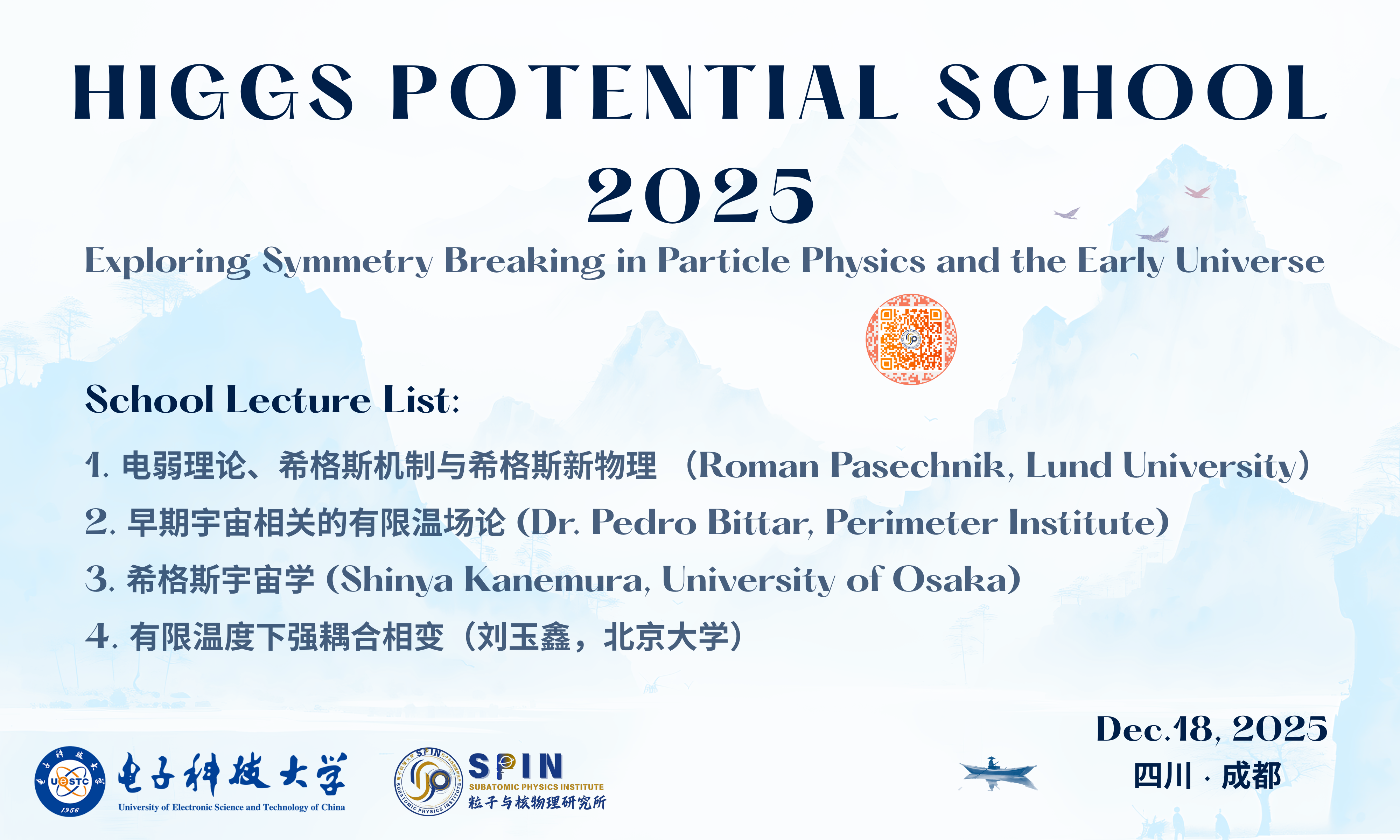
希格斯势 2025:探索粒子物理与早期宇宙中的对称性破缺
将于2025年12月18日至12月22日在电子科技大学清水河校区举办
English Version Follows
自希格斯粒子被发现以来,对其性质的精确测量、电弱对称性破缺机制的深入理解,以及对超越标准模型新物理的探索,始终是大型强子对撞机(LHC)及未来对撞机实验的核心科学目标。对称性的自发破缺不仅构成现代粒子物理标准模型的基石,也为构建新物理机制提供了重要线索。
本次会议将围绕希格斯物理的最新进展,深入探讨希格斯粒子的实验观测结果及其在粒子物理理论和早期宇宙研究中的拓展,重点涵盖以下方向:
此外,会议将特别关注早期宇宙相变与对撞机实验之间的交叉关联,推动从宇宙学与高能物理的双重视角深化对希格斯机制的理解。会议拟邀请国内外理论与实验物理学者,共同交流希格斯物理与对称性破缺方向的最新研究进展,推动相关研究的纵深发展,并进一步加强在该前沿方向上的国际合作。
本次会议由电子科技大学主办,重庆大学西南理论物理中心,北京大学,南京大学,清华大学,中国科学技术大学,中国科学院理论物理研究所,中山大学及上海交大李政道研究所协办。举办地在电子科技大学(中国成都)。会议得到重庆大学西南理论物理中心的部分资助。
会议有关事项:
一:会议时间:
2025年12月18日:希格斯冬季学校
2025年12月19日至12月21日:线下报告
2025年12月22日下午:离会
二:会议注册
网上注册截止日期:2025年12月8日
会议网址:https://indico-tdli.sjtu.edu.cn/event/4384/
三:会议注册费(现场缴费)
教师:1500元
学生、博士后:1000元
会议期间餐饮住宿及交通费用自理。
四:组织委员会(拼音顺序)
安海鹏(清华大学)
边立功 (重庆大学)
曹庆宏(北京大学)
蒋贇(中山大学)
Roman Pasechnik (瑞典隆德大学)
王志伟(电子科技大学,大会主席)
徐来林(中国科学技术大学)
杨洪洮(中国科学技术大学)
于江浩(中国科学院理论物理研究所)
张雷(南京大学)
五:会议国际学术顾问委员会
主席(按姓名序排列):
何小刚(李政道研究所)
Francesco Sannino(丹麦高等研究中心,量子物理研究中心)
委员会成员(按姓名序排列):
毕效军(中科院高能所)
蔡一夫(中国科学技术大学)
龚云贵(宁波大学)
黄梅(中国科学院大学)
刘江来(李政道研究所)
舒菁(北京大学)
王伟(上海交通大学)
武雷(南京师范大学)
杨金民(中国科学院理论物理研究所)
周宁(上海交通大学)
六:会务秘书
江璐
电话:15021500353
Higgs Potential 2025:
Exploring Symmetry Breaking in Particle Physics and the Early Universe
Since the discovery of the Higgs boson, the precise measurement of its properties, a deeper understanding of the mechanism of electroweak symmetry breaking, and the exploration of new physics beyond the Standard Model have remained central scientific goals of the Large Hadron Collider (LHC) and future collider experiments. The spontaneous breaking of symmetry not only forms the cornerstone of the Standard Model of modern particle physics but also provides important clues for constructing new physics frameworks.
This conference will focus on the latest developments in Higgs physics, with in-depth discussions on experimental observations of the Higgs boson and their implications for particle physics theory and early-universe research. Key topics include:
In addition, the conference will place special emphasis on the interplay between early-universe phase transitions and collider experiments, aiming to advance the understanding of the Higgs mechanism from both cosmological and high-energy physics perspectives. Leading theoretical and experimental physicists from China and abroad will be invited to exchange the latest research progress on Higgs physics and symmetry breaking, to promote further development in this frontier field, and to strengthen international collaboration.
This conference is hosted by the University of Electronic Science and Technology of China (UESTC), with co-sponsorship from Chongqing University’s Southwest Center for Theoretical Physics, Peking University, Nanjing University, Tsinghua University, the University of Science and Technology of China, the Institute of Theoretical Physics of the Chinese Academy of Sciences, Sun Yat-sen University, and the Tsung-Dao Lee Institute at Shanghai Jiao Tong University.
It will be held at the University of Electronic Science and Technology of China in Chengdu, China, and is partially supported by the Southwest Center for Theoretical Physics at Chongqing University.
Conference Information
1. Conference Dates
2. Registration
3. Registration Fees (payable on site)
4. Organizing Committee (in alphabetical order by pinyin)
5. International Academic Advisory Committee
6. Conference Secretary

本讲座以强相互作用物质相变的观点简要讨论可见物质粒子及其质量的起源,包括由其基本现象归结为相变的物理机制、强关联非微扰系统相变的判据、以及相关研究的进展现状。
Some recent progresses will be introduced from the LHC CMS experiment on multi-boson physics, including, e.g., studying anomalous couplings from Same-Sign WWH, probing boosted Higgs through the WW decay channel, and searching for diboson resonances such as Higgs plus a photon.
The discovery of the Higgs boson has opened a new window into physics beyond the Standard Model. In this talk, I will discuss how the Higgs serves as a unique tool to probe the Dark Sector. I will cover three complementary strategies: constraining Dark Matter models via precision Higgs coupling measurements, performing direct Higgs portal searches, and exploring extended Higgs sectors that could bridge the visible and BSM.
该报告介绍最近cms实验上的希格斯物理方面的最新进展。
Higgs decaying to LLPs is an important part of the LLP search. In the past decade, ATLAS has established a comprehensive search programme covering a wide range of lifetimes. Due to the reconstruction and triggering challenges, dedicated analysis strategies have to be crafted, often resulting in analyses optimised for a very particular phase space. I will give a chronical review of how ATLAS managed to close the gaps gradually in LLP searches and standardise the LLP searches.
In this talk we present a phenomenological search for exotic Higgs decays to light BSM particles at future muon colliders.
Extra-dimensions are a very interesting tool to address various missing parts of the Standard Model of particle physics. When one extra-dimension is added, a compactification based on a orbifold is required to ensure a chiral spectrum for the fermions. It also allows mechanisms to consistently break the bulk gauge group. Symmetry breaking on orbifolds can be understood in two different ways: through the boundary conditions imposed on the fields by the orbifold structure or through the vacuum structure of the fifth component of the gauge fields, the "gauge-scalar". We will use those mechanisms to build consistent 5D GUTs. We will focus on theories featuring an asymptotic behaviour for the running of the gauge couplings, dubbed asymptotic GUTs (aGUTs).
The ATLAS and CMS experiments are unique drivers of our fundamental understanding of nature at the energy frontier. In this contribution to the update of the European Strategy for Particle Physics, we update the physics reach of these experiments at the High-Luminosity LHC (HL-LHC) in a few key areas where they will dominate the state-of-the-art for decades to come.
This talk will present a key advancement from the ATLAS experiment in probing the rare decay of the Higgs boson to a pair of muons (H→μμ). By analysing the new proton-proton collision data from LHC Run 3 (2022-2024) and combining it with Run 2 data, incorporating several technical improvements, we have performed the most sensitive combined measurement to date. The result provides the first evidence for the H→μμ decay with a significance of 3.4σ by ATLAS, marking a significant milestone in directly probing the Yukawa coupling between the Higgs boson and second-generation fermions.
In addition to the well-known quantum chromodynamical theta angle, we show that the Standard Model has another theta angle which is invariant under arbitrary chiral rotations of quarks and leptons. The new theta angle coincides with the quantum electrodynamical theta angle, which may be observable in a spacetime with nontrivial topology, either beyond the visible universe or in an effective background from a laboratory setup
Ref. Phys. Rev. Lett. 134 (2025) 121801
A search is performed for dark matter particles produced in association with a resonantly produced pair of b-quarks with $30 < m_{bb} < 150$ GeV using 140 fb$^{−1}$ of proton-proton collisions at a center-of-mass energy of 13 TeV recorded by the ATLAS detector at the LHC. This signature is expected in extensions of the Standard Model predicting the production of dark matter particles, in particular those containing a dark Higgs boson s that decays into $b\bar{b}$. The highly boosted s→$b\bar{b}$ topology is reconstructed using jet reclustering and a new identification algorithm. This search places stringent constraints across regions of the dark Higgs model parameter space that satisfy the observed relic density, excluding dark Higgs bosons with masses between 30 and 150 GeV in benchmark scenarios with Z′ mediator masses up to 4.8 TeV at 95% confidence level. The result leads to the 1$^{st}$ ever cosmological coherent dark Higgs search at LHC.
Ref. Phys. Rev. D 111 (2025) 032006
The 1$^{st}$ ever search for the production of three Higgs bosons (𝐻𝐻𝐻) at LHC has been performed in the $b\bar{b}b\bar{b}b\bar{b}$ final state is presented. The search uses 126 fb$^{−1}$ of proton-proton collision data at √𝑠 =13 TeV collected with the ATLAS detector at the Large Hadron Collider. The analysis targets both non-resonant and resonant production of 𝐻𝐻𝐻. The resonant interpretations primarily consider a cascade decay topology of 𝑋→𝑆𝐻→𝐻𝐻𝐻 with masses of the new scalars 𝑋 and 𝑆 up to 1.5 and 1 TeV, respectively. In addition to scenarios where 𝑆 is off-shell, the nonresonant interpretation includes a search for Standard Model 𝐻𝐻𝐻 production, with limits on the trilinear and quartic Higgs self-coupling set. No evidence for 𝐻𝐻𝐻 production is observed. An upper limit of 59 fb is set, at the 95% confidence level, on the cross section for Standard Model 𝐻𝐻𝐻 production.
In this talk, we present our recent work at the frontier of multi-loop Feynman integrals and scattering amplitudes for precision physics. We have analytically computed two-loop six-point and three-loop five-point integrals, which represent the current state of the art in analytic Feynman integrals. Using these results and new reduction tools based on algebraic geometry, we have calculated the full-color two-loop QCD corrections for Higgs boson production in association with a bottom quark pair.
In this talk I would like to introduce the state-of-the-art parton level event generator NNLOJET and its application to precision phenomenology of the Higgs boson. The main theory uncertainties of the Higgs boson production at hadron collider are from the parton distribution functions and determination of the strong coupling alpha_s. We have made NNLO QCD accurate PDF grids to help improve both alpha_s and PDF fitting. For di-Higgs production at hadron colliders, we for the first time predicated fully differential cross sections at N3LO QCD accuracy and revealed detailed corrections for the shape of several differential observables. For lepton colliders, we have also studied at N3LO accuracy the Higgs hadronic decay properties. The application of the decay processes to the main ZH production channel will also be discussed.
Modern collider phenomenology requires unprecedented precision for the theoretical predictions, for which slicing techniques provide an essential tool at next-to-next-to-leading order (NNLO) in the strong coupling. The most popular slicing variable is based on the transverse momentum qT of a color-singlet final state, but its generalization to final states with jets is known to be very difficult. Here we propose two generalizations of qT that can be used for jet processes, providing proof of concept with an NLO slicing for pp → 2 jets. We present factorization formulae that enable our approach to NNLO, calculate the NNLO collinear-soft function and demonstrate slicing at this order for e+e− → 2 jets. One of these generalizations of qT only applies to planar Born processes, such as pp → 2 jets, but offers a dramatic simplification of the soft function. We also discuss how
our approach can directly be extended to obtain predictions for the fragmentation of hadrons. This presents a promising path for high-precision QCD calculations with multi-jet final states.
Parameters in an effective field theory can be subject to certain positivity bounds if one requires a UV completion that obeys the fundamental principles of quantum field theory. These bounds are relatively straightforward at the tree level, but would become more obscure when loop effects are important. In this talk, I will discuss the impacts of loop contributions to the interpretation of positivity bounds, using scalar theories and Scalar QED as examples. In particular, a strict positivity bound can only be implied when all contributions at the same loop order are considered, and the one-loop generated dimension-8 operator coefficients (as well as their beta functions) may not be subject to the tree-level bounds.
We explore the surviving parameter space for sub-GeV thermal Dark Matter (DM) within Higgs-portal models, analyzing both a minimal Majorana DM scenario with a singlet scalar mediator and leptophilic DM scenarios. These light DM candidates face severe constraints from the observed relic density, Cosmic Microwave Background (CMB) measurements, and direct detection experiments. Our comprehensive analysis shows that the introduction of pseudo-scalar or leptophilic couplings is critical to evade stringent direct detection limits. Crucially, we identify the mediator resonance region as a distinct and robust parameter space that simultaneously satisfies all cosmological and direct detection constraints. This resonance mechanism provides a natural "sweet spot" that is uniquely accessible to next-generation indirect detection missions. We demonstrate that future MeV-GeV gamma-ray telescopes, such as e-ASTROGAM and the Very Large Area Space Telescope (VLAST), offer unprecedented sensitivity to definitively probe and test this key surviving region, thereby bridging the long-standing "MeV Gap" in DM searches.
I will introduce cosmological and gravitational-wave aspects of phase-transition phenomenology, including bubble nucleation and expansion dynamics, gravitational-wave generations, curvature perturbations, primordial black holes, and, in particular, the induced gravitational waves from primordial gravitational collapse at non-linear and non-perturbative levels.
Domain walls (DWs) are topological defects arising from spontaneous breaking of discrete symmetries. The DW property is determined by both the symmetry and potential of the new Higgs which triggers the symmetry breaking. While most phenomenological studies on GWs from DWs focus on those from Z2 breaking, I will extend to those beyond Z2. The latter are widely predicted in, e.g., flavour symmetries in quark or lepton sectors, remnant discrete symmetries from the breaking of Peccei-Quinn symmetry, etc. In this talk, after a brief review of Z2 DW, I will discuss the properties of DWs from general ZN breaking with N an integer, referring to Abelian DWs. Then, I will move to non-Abelian DWs, namely, DWs arising from non-Abelian discrete symmetry breaking. I will focus on the widely studied octahedral symmetry S4 and tetrahedral symmetry A4. I will also discuss on gravitational waves related to these DWs, in particular their differences from the that from Z2 DWs
Higgs field in cosmology
In this talk, I will present the physics induced by the electroweak symmetry non-restoration (ESNR) in the early universe. I will show that ESNR may trigger SU(3)_C symmetry breaking and restoration. In addition, ESNR can also trigger the Leptogenesis without requiring any B-L violation.
In this talk, we will discuss the potential of investigating quantum entanglement effects at Higgs factory.
Directly probing light-quark Yukawa couplings and their flavor structure remains a major challenge due to their smallness and overwhelming QCD backgrounds. In this Letter, we propose a theoretical framework to access these couplings at future lepton colliders through transverse spin dependent azimuthal modulations in dihadron fragmentation.
These modulations arise from the interference between Higgs mediated and Standard Model (SM) amplitudes in $e^-e^+\to q\bar{q}Z$, producing angular structures that are linearly sensitive to the Yukawa couplings $y_q$, in contrast to conventional observables that scale as $y_q^2$. By combining channels with an identified accompanying single hadron, $h^\prime=\pi^\pm,K^\pm$, and $p/\bar{p}$, this approach cleanly disentangles the up- and down-quark Yukawa contributions, yielding typical limits at the $\mathcal{O}(10^{-3})$ level and establishing fragmentation dynamics as a novel and complementary probe of the Higgs flavor structure.
We derive a set of linear UV unitarity conditions that go beyond positivity and are easy to implement in an optimization scheme with dispersion relations in a multi-field EFT. We apply it to Higgs self scattering and compare the newly obtained upper bounds with the traditional perturbative unitarity bounds from within the EFT, and discuss some phenomenological implications of the two-sided positivity bounds in the context of experimental probes of Vector Boson Scattering. We also compute the direct detection cross section of TeV WIMPs, using current experimental limits to constrain the interaction of Higgs and WIMP dark matter.
The Next-to-Two-Higgs-Doublet model (N2HDM) has a rich vacuum structure where multiple electroweak (EW) breaking minima, as well as CP and electric-charge breaking minima, can coexist. These minima can be deeper than the electroweak vacuum $v_{𝑒𝑤} \approx 246$ GeV of our universe, making our vacuum metastable. In such a case, one needs to calculate the tunneling rate from the EW vacuum to the deeper minimum. If the decay rate is larger than the universe's age, our vacuum is deemed long-lived, and the parameter point is in principle allowed. If the decay rate is smaller than the universe's age, then our vacuum is unstable and the parameter point is ruled out. However, domain walls (DW) in the N2HDM can substantially alter this picture. We show in this work that inside the DW, the barrier between our electroweak minimum and the deeper minimum can disappear, leading the scalar fields to classically roll over to the deeper minimum that nucleates inside the DW and then expands outside of it everywhere in the universe. We show that such behavior can happen to parameter points where the lifetime of our vacuum is several orders of magnitude larger than the age of the universe, making these parameter points with very long-lived EW minimum ruled out.
We investigate a cosmological scenario in which the Peccei-Quinn (PQ) symmetry remains broken in the entire history of the Universe, thereby avoiding the formation of axion strings and domain walls. Contrary to the conventional expectation, it is demonstrated that appropriately chosen scalar interactions are able to keep the PQ symmetry broken at arbitrarily high temperatures. We carefully examine the finite-temperature effective potential in a model with two PQ breaking scalar fields. The existence of flat directions plays a vital role in suppressing axion isocurvature perturbations during inflation by stabilizing a PQ field at a large field value. The viable parameter space consistent with theoretical and observational constraints is identified. Our scenario provides a minimal path for PQ symmetry breaking that addresses both the axion domain wall and isocurvature problems while permitting arbitrarily high reheating temperatures accommodating high-scale baryogenesis scenarios such as thermal leptogenesis.
We investigate a framework of the Minimal Supersymmetric Standard Model
(MSSM) in which the quark and lepton flavor structure and suppression of flavor-
changing neutral currents (FCNCs) are governed by non-invertible selection rules.
By implementing such non-group-like fusion rules for matter fields, arising from
gauging the outer automorphism Z2 of a discrete ZN symmetry, we obtain real-
istic Yukawa textures that reproduce the observed quark and lepton masses and
mixings while ensuring diagonal soft supersymmetry (SUSY) breaking masses and
hence suppressing dangerous FCNC processes. We analyze mass insertion pa-
rameters under random O(1) coefficients and find that all flavor-violating effects
are consistent with experimental limits on processes such as μ → eγ and meson
mixings. We show that the Yukawa textures and soft terms remain stable un-
der renormalization group evolution. Our results demonstrate that non-invertible
selection rules provide a compelling new mechanism to address both the flavor
structure and FCNC problems in supersymmetric models.
The strong CP problem remains one of the most important unresolved issues in the Standard Model. Spontaneous CP violation (SCPV) is a promising approach to the problem by assuming that CP is an exact symmetry of the Lagrangian but broken spontaneously at the vacuum, which enables the generation of the observed Cabibbo-Kobayashi-Maskawa (CKM) phase without reintroducing a nonzero strong CP phase. Supersymmetry (SUSY) provides a natural framework to accommodate such a mechanism, as SUSY can not only protect the scale of SCPV from radiative corrections but also suppress problematic higher-dimensional operators generating a strong CP phase. In the present study, we explore the realization of SCPV in two distinct SUSY scenarios. First, we investigate SCPV in the exact SUSY limit, extending the spurion formalism developed in non-supersymmetric theories and introducing a method to determine whether the given superpotential satisfies the necessary condition for SCPV. Second, we construct a model in which CP is spontaneously broken at an intermediate scale along pseudo-flat directions, stabilized by soft SUSY breaking and non-perturbative effects of a gauge theory. The latter setup predicts light scalars in the SCPV sector whose masses are determined by the SUSY breaking scale.
CP4 3HDM is a three-Higgs-doublet model based on the CP symmetry of order 4 (CP4) without any accidental symmetries. When exploring the scalar and Yukawa sector phenomenon of this model, the usual scan procedure is computationally time-consuming and inefficient. A much better scanning procedure, which we call the inversion, is to identify a set of crucial physical observables, to use them as input parameters, and to reconstruct the coefficients in the potential and Yukawa matrix. In this work, we construct inversion in the scalar sector and lepton Yukawa sector of CP4 3HDM. Furthermore, we investigate two lepton flavor violation (LFV) processes, the leptonic decay of the SM-like Higgs boson and the radiative decay of the muon, and use these processes to constrain the lepton Yukawa sector of the model.
Long-lived particles (LLPs) originating from decays of Standard-Model-like or beyond-the-Standard-Model Higgs bosons are often featured with signatures of displaced vertices (DVs) and jets at colliders. In this work, we show that a recent ATLAS search for DVs plus jets, with its recast implementation, can efficiently place bounds on such hadronically or semileptonically decaying LLPs. In particular, we find the search is uniquely sensitive to LLP proper decay lengths of about 1-100 mm, probing complementary regions in the parameter space of the relevant models compared to other prompt and LLP searches.
This talk presents the latest results from the CMS experiment on rare and exotic decays of the Higgs boson, which serve as crucial portals to physics beyond the Standard Model (BSM). Key highlights include the first evidence of the H→μμ decay, probing the second-generation Yukawa coupling, and the H→Zγ decay, with a combined significance of 3.4σ. Searches for H→cc̅, decays to mesons, invisible decays, and exotic decays such as H→aa→4e are also discussed, showcasing advanced analysis techniques including graph neural networks. All results are consistent with Standard Model predictions so far. With ongoing Run-3 data collection and future HL-LHC operations, the sensitivity to these rare processes is expected to improve significantly.
Ref. ATLAS-CONF-2025-012
This note presents a combination of searches for Higgs boson pair (HH) production performed by the ATLAS and CMS Collaborations using proton-proton collision data sets recorded at $\sqrt{s}$ = 13 TeV at the LHC Run 2, corresponding to integrated luminosities ranging between 126 and 140 fb$^{-1}$. The upper limit at the 95% confidence level on the total HH production cross section corresponds to 2.5 times the standard model (SM) prediction with an expected value of 1.7 (2.8) assuming the absence (presence) of the SM HH signal. The strength of the HH signal is measured to be 0.8$^{+0.9}_{-0.7}$ relative to the SM prediction. The observed significance is found to be 1.1 standard deviations when 1.3 are expected for the SM HH signal. Constraints are set on the Higgs boson trilinear self-coupling and on the couplings of two Higgs bosons to two vector bosons, both normalized to the SM predictions and denoted as $\kappa_\lambda$ and $\kappa_{2V}$, respectively. The observed individual constraints at the 95% confidence level are $-0.71 < \kappa_\lambda < 6.1$ and $0.73 < \kappa_{2V} < 1.3$, while the expected constraints assuming the presence of the SM HH signal are $-1.3 < \kappa_\lambda < 6.7$ and $0.66 < \kappa_{2V} < 1.4$.
Recent measurements of single top-Higgs (tH) production at the LHC show consistent excesses above Standard Model predictions across multiple decay channels. While still statistically limited, these observations are intriguing given tH's unique sensitivity to the relative sign between top Yukawa and W boson couplings. This talk summarizes the current experimental landscape, and ongoing dedicated tH analyses and combination efforts.
I will present a new jet-free strategy for the $HH \to 4b$ search at the LHC that enhances sensitivity by more than a factor of five compared with current approaches. The method uses all-particle inputs to jointly identify $h_1 h_2 \to 4b$ across variable Higgs-candidate masses and to estimate $(m_{h_1}, m_{h_2})$ via a mass-decorrelated multiclass classifier. A key feature is that the $HH$ response can be calibrated directly using the $ZZ \to 4b$ proxy. After validating the framework with a high-fidelity simulation workflow, we find that two experimental conditions are crucial for reaching the demonstrated performance. With Run 2+3 data, this approach puts an observation of di-Higgs production within reach and opens the door to constraints on $\kappa_\lambda$ competitive with HL-LHC expectations. I will discuss both the methodology and its implications for redefining the LHC's search potential in di-Higgs studies.
This talk is based on arXiv:2508.15048v2.
The origin of the Higgs boson ($H_{125}$), discovered in 2012, remains a mystery. In the metric affine theory (MAT) framework, we study the scalar potential and investigate a couple of scenarios for the symmetry breaking mechanisms with a dilaton model which is derived from the geometry. The LHC constraints for the couplings of Yukawa couplings, Higgs-weak vector bosons and Higgs self-couplings, in this model are examined, which identify the parameter space where the discovered Higgs boson $m_h=125$ GeV can be dilaton-dominant and the features of Higgs self-couplings are explored. It is found that via the measurements of Higgs pair production, the High Luminosity LHC (HL-LHC) running can either confirm or rule out the dilaton dominance.
We present a supersymmetric Pati-Salam model with small representations as a potential candidate for physics beyond the Standard Model. The model features a Higgs sector with bifundamental fields $H_R+\bar H_R=(4,1,2)+(\bar 4,1,2)$, $H_L+\bar H_L=(4,2,1)+(\bar 4,2,1)$ as well as a pair of bi-doublet fields $h_a=(1,2,2)$ where $ a=1,2$, with three families of fermions accommodated in $ (4,2,1)+(\bar 4,1,2)$ as usual. The matter spectrum is augmented with three copies of neutral singlets that mix with ordinary neutrinos to realize the seesaw mechanism. The model introduces supersymmetric R-symmetry and a global discrete $\mathbb{Z}_n$ symmetry ($n > 2$) that prevents disastrous superpotential couplings, while its spontaneous breaking implies the existence of domain walls that are successfully addressed. Interestingly, the one-loop beta coefficient of the $SU(4)_C$ gauge coupling is zero in the minimal $\mathbb{Z}_3$ model, rendering the corresponding gauge coupling near-conformal in the UV. Meanwhile, Landau poles are avoided up to the Planck scale and proton decay is suppressed, resulting in a proton lifetime beyond current experimental bounds. By virtue of the extended Higgs sector, the key advantage of this PS model is its ability to disentangle quark and lepton masses through higher-dimensional effective operators, addressing a common limitation in GUT models with small Higgs representations. This makes the model more economical and easier to be constructed from string theory, particularly in several heterotic and F-theory models where Higgses in the adjoint representation are absent.
我们将在报告中讨论有限温度场论在电弱相变研究中的规范依赖性。
We propose a novel approach to calculate the false vacuum decay rate, which goes beyond the saddle-point approximation when large thermal fluctuations appear. Utilizing the extension of the Wigner function in quantum field theory, we numerically calculate the decay rate of the false vacuum through functional integral. We observe that the decay rate for the thermal fluctuation scenarios and its dependence on the potential shape, and found that the false vacuum decay occurs following an exponentially decay rate, and the speed of vacuum decay decreases when the initial energy of the system decreases and the potential height increase.
We propose a parametrization of neutrino masses and mixing in the minimal seesaw model (MSM). The MSM, which introduces two heavy sterile neutrinos, is the minimal extension of the Standard Model in addressing the tiny masses of active neutrinos. The parametrization includes 11 free parameters: 6 neutrino oscillation parameters (2 mass-squared differences $\Delta m^2_{21}$, $\Delta m^2_{31}$, 3 mixing angles $\theta_{12}$, $\theta_{13}$, $\theta_{23}$, and 1 Dirac phase $\delta_{\rm CP}$), 1 mass parameter in $0\nu2\beta$ decay $m_{ee}$, and 4 additional parameters: 2 heavy neutrino masses $M_1$ and $M_2$, 1 active-sterile mixing angle $\theta_{14}$ and 1 CP-violating phase $\delta_{14}$. This parametrization is derived exactly from the most general neutrino mass matrix in the MSM without any approximation. We further discuss its implications in phenomenological studies.
GUTs unify quarks and leptons into same representations and predict correlations between their masses and mixing. We take new data of JUNO and perform numerical scans to explore the flavor space compatible with data in SO(10) GUTs. The quark-lepton correlation shows the preference of normal ordering for light neutrino masses, predicts favored region of the CP-violating phase in neutrino oscillations, and classifies GUT models based on their testability in neutrinoless double beta decay experiments. The quark-lepton correlation predicts mass spectrum of right-handed neutrinos, pointing to the energy scale of baryon and lepton number violation and providing sources for baryogenesis. We emphasize that, as the high precision measurements of neutrino physics is coming, the quark-lepton correlation will provide increasingly important role in the testability of GUTs, complementary to the proton decay measurement.
Although the Standard Model has achieved remarkable success, its limitations motivate physicists to continuously explore new fundamental particle theories. Among the numerous candidate theories, Grand Unified Theories (GUTs) have attracted significant attention due to their simplicity and potential to unify the three fundamental interactions.
We present a detailed study of the running of gauge couplings along several gauge symmetry breaking chains (SWW, WSW, and WWS) in the SU(8) Grand Unified Theory. By relaxing the third law of grand unification proposed by H. Georgi, we obtain the left-handed fermion representation set with the minimal fermion degrees of freedom in this GUT while ensuring anomaly cancellation. Furthermore, from the perspectives of gauge symmetry and global symmetry, we determine the representations of Higgs fields and Yukawa interactions.
The massless fermion spectrum, the two-loop renormalization group equations for gauge couplings at each stage, the CKM mixing matrix, and the relationship between gauge couplings before and after symmetry breaking are derived in detail by analyzing the breaking of the group structure. We then provide benchmark points for some parameters (especially each symmetry breaking scale) based on the measured values of the CKM matrix. Using the renormalization group equations, we calculate the coupling constants at different stages and plot the coupling running diagrams.
The results show that the minimal setup of the SU(8) GUT does not achieve the unification of gauge couplings. However, introducing numerous additional Higgs fields can strengthen the coupling strength of non-Abelian groups, leading to an unnatural unification. Moreover, the $\mathcal{N}$ = 1 supersymmetric extension can modify the $\beta$ coefficients and achieve the unification of coupling constants within the framework of affine Lie algebra. These results provide important references for the development of GUTs and demonstrate the potential of the SU(8) GUT in unifying gauge interactions.
The hot early Universe must have evolved through phase transitions around the electroweak epoch. In multi-Higgs models, this evolution could be much more intricate than a single-step EWPT. In this talk, I will discuss a peculiar regime in the two-Higgs-doublet model, in which thermal evolution of the early Universe passes through an intermediate phase with a charge-breaking vacuum. Remarkably, this regime is realized in a specific part of the parameter space that can be tested at colliders. I will also argue that multi-Higgs-doublet models allow for a different type of phase transitions, with two neutral minima separated by a charge-breaking bubble wall. This intriguing evolution scenario remains largely unexplored.
We discuss the intriguing possibility that the recently reported nano-Hz gravitational wave signal by Pulsar Timing Array (PTA) experiments is sourced by a strong first-order phase transition in a dark sector. The phase transition has to be strongly supercooled to explain the signal amplitude. However, such strong supercooling exponentially dilutes away any pre-existing baryon asymmetry and dark matter, calling for a new paradigm of their productions. We then develop a mechanism of cold darkogenesis that generates a dark asymmetry during the phase transition from the textured dark SU(2) Higgs field. This dark asymmetry is transferred to the visible sector via neutron portal interactions, resulting in the observed baryon asymmetry. Furthermore, the mechanism naturally leads to the correct abundance of asymmetric dark matter. Collider searches for mono-jets and dark matter direct detection experiments can dictate the viability of the model. We also discuss another scenario of darkogenesis where the number asymmetry is generated from the decay of a mother particle produced via parametric resonance during the phase transition induced due to its coupling to the order parameter scalar. It is shown that the correct baryon asymmetry and dark matter abundance can be realized for a dark phase transition at O(1) GeV. The scenario will be tested further in neutron-antineutron oscillation experiments.
Cosmological phase transitions played a crucial role in shaping the early universe. This talk explores non-standard first-order transitions with extremely low nucleation rates, highlighting two novel possibilities: transitions completing with super-Hubble bubble separation, and bubble-free transitions driven by collapsing domain-wall structures. These scenarios lead to distinctive cosmological signatures—including primordial black holes, topological-defect dynamics, and unconventional gravitational-wave spectra—broadening the landscape of testable early-universe physics.